Keep rats, mice, and wild birds out of chicken feeders by combining sealed bulk storage, controlled feeder access, immediate spill cleanup, and physical exclusion. A feeder alone cannot solve a site that provides food, water, shelter, and entry gaps.
Wild birds and rodents consume feed, contaminate surfaces, and can undermine biosecurity. If you see an active infestation, protect children and pets and use a licensed pest professional when needed.
Remove the easy meal
- Store unopened and opened feed in a clean container with a tight-fitting lid.
- Do not leave feed bags loose in the coop, garage, or shed.
- Sweep or collect spills before dusk.
- Remove open feeders at night or use a correctly adjusted controlled-access feeder.
- Discard feed contaminated with droppings, urine, insects, mold, or moisture.
For container choice and rotation, see how to store chicken feed safely.

Choose access that fits your flock
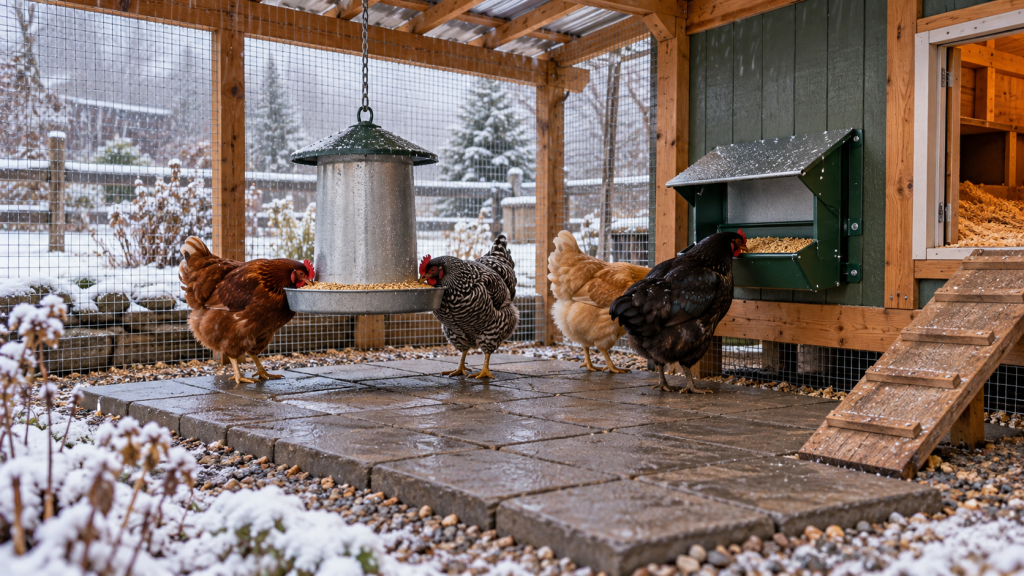
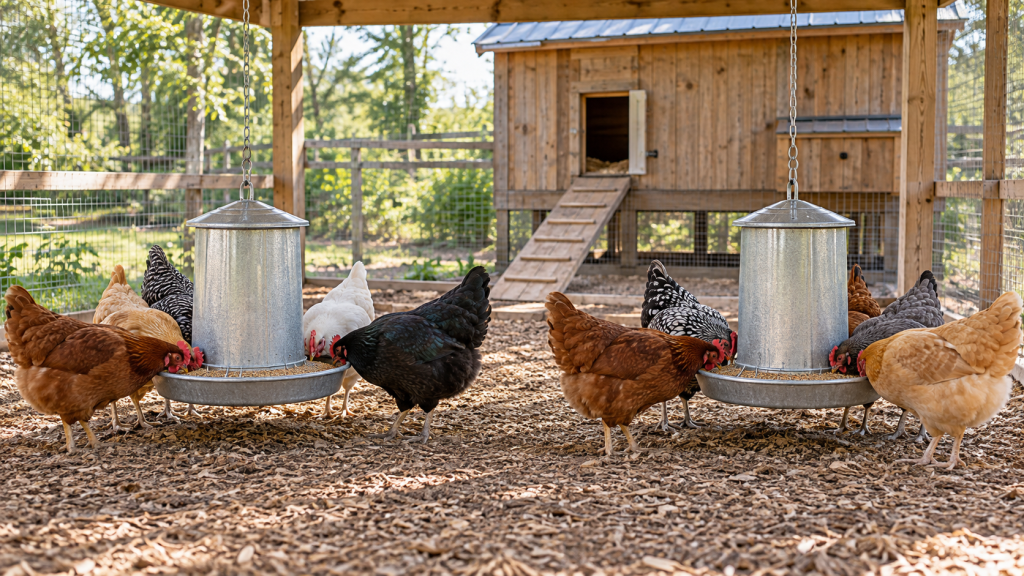
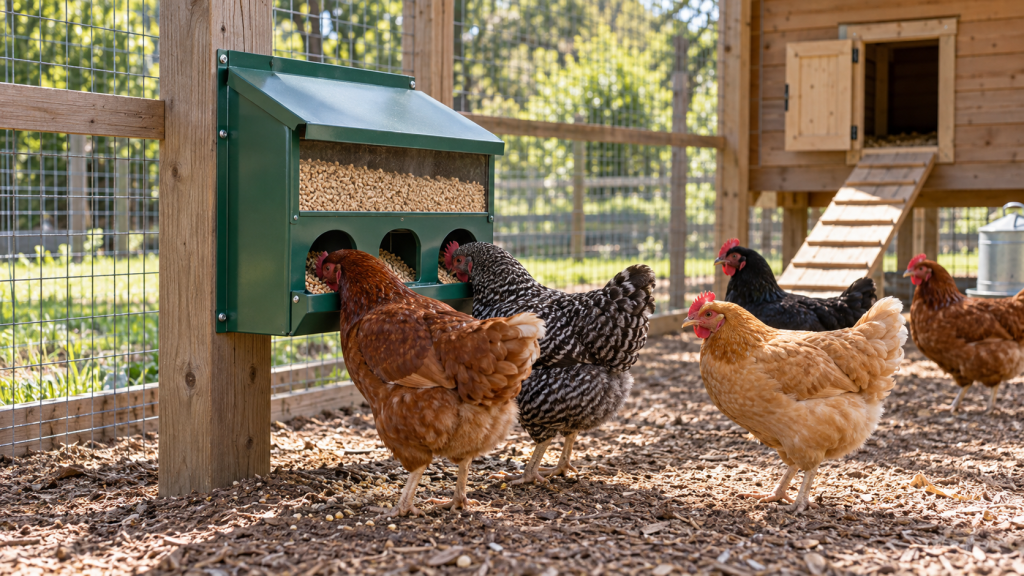
A treadle feeder closes between visits and can reduce access by rodents and wild birds. It still requires correct assembly, weight adjustment, training, and inspection. A wall-mounted port feeder limits raking but remains open through its ports. A gravity feeder is simple, yet its tray is accessible to any animal that enters the run.
Compare the practical tradeoffs in treadle feeder vs. gravity feeder. Never deny a timid or lightweight hen food simply to close a feeder more aggressively.

Exclude pests from the run and storage area
- Repair torn hardware cloth and close gaps around doors, eaves, pipes, and foundations.
- Use secure latches; inspect corners and ground-level edges for gnawing or digging.
- Trim dense vegetation and remove clutter that offers cover.
- Fix water leaks and eliminate standing water.
- Keep wild-bird feeding stations well away from poultry areas.
Read our broader rat and mouse control guide and fall biosecurity checklist.
Monitor without contaminating the flock area
Look for droppings, gnaw marks, greasy rub marks, tunnels, feathers from wild visitors, or feed disappearing overnight. Record where signs occur. Avoid scattering poisons or placing accessible traps where chickens, pets, children, or wildlife can reach them. Follow local rules and product labels.

Daily closing routine
- Confirm all hens have eaten and returned to the secure coop.
- Close or remove accessible feed as appropriate for your feeder.
- Collect spills and damp clumps.
- Secure the bulk-storage lid.
- Walk the run perimeter and check latches.
The chicken feeder guide explains placement and daily inspections for every feeder type.
Wild-bird controls are biosecurity controls
Do not rely on scare devices alone. Deny entry and remove shared resources. Roof or screen feeding areas where practical, repair openings, and avoid throwing scratch outside the run. Clean waterers as carefully as feeders because wild birds seek both. Keep flock equipment separate from wild-bird feeding supplies.
What not to do
- Do not scatter poison where chickens, pets, children, or non-target wildlife can reach it.
- Do not block a feeder so aggressively that a lightweight or timid hen cannot eat.
- Do not sweep contaminated feed into the yard.
- Do not seal a coop without preserving safe ventilation.
- Do not assume a lack of daytime sightings means rodents are gone.
Respond to evidence in order
- Photograph and map droppings, gnawing, tracks, tunnels, or entry damage.
- Secure all bulk feed and remove open food before night.
- Clean spills and remove clutter.
- Repair access points with durable, poultry-safe materials.
- Monitor for several nights and document whether signs decline.
- Use a qualified pest professional if activity persists.
If a feeder is contaminated, discard the ration in a closed container, clean the feeder appropriately, and let it dry fully. Contact a veterinarian if birds appear ill.
Keep the solution working
Pest pressure can return with colder weather, harvest, construction, or nearby habitat changes. Review storage lids, run edges, door sweeps, and feeder closure weekly. Record feed use so an unexplained increase is noticed early. Continue exclusion even after signs disappear; removing the food reward is more reliable than reacting only when an animal is seen.
Why feeder access is more than a feed-cost problem
Rodents consume feed, contaminate more than they eat, damage structures, and can carry pathogens and parasites. Wild birds can contaminate feed, water, soil, and equipment with droppings. USDA APHIS identifies wild birds and other wildlife as biosecurity risks and recommends protecting food resources, repairing entry points, removing standing water, and avoiding practices that attract wildlife.
The practical goal is not merely to stop seeing animals during chores. It is to remove food, water, shelter, and entry opportunities, then monitor for fresh evidence. A feeder is one layer within that system.
Identify who is reaching the feed
| Evidence | Possible visitor | Where to inspect |
|---|---|---|
| Small dark droppings, fine gnawing, feed taken in small amounts | Mouse | Wall edges, storage shelves, insulation, and gaps around pipes |
| Larger droppings, burrows, greasy rub marks, strong gnawing | Rat | Ground-level edges, foundations, drains, clutter, and nearby cover |
| Daylight visits, feathers, droppings on lids or perches | Wild birds | Roof gaps, open doors, uncovered runs, and nearby bird-feeding areas |
| Feed scattered with no clear tracks | Chicken billing or another animal | Feeder height, tray depth, camera footage, and overnight access |
| Damaged lid or overturned container | Larger wildlife | Latches, run perimeter, doors, and storage-room security |
Do not identify a species from droppings alone if the evidence is uncertain. Photograph signs, note their size and location, and consult a local extension office, wildlife professional, or pest professional when correct identification affects the control method.
Use an integrated prevention hierarchy
- Remove the reward: contain feed, clean spills, secure waste, and eliminate accessible water.
- Exclude entry: repair gaps, doors, screens, and hardware cloth with durable materials.
- Reduce shelter: remove clutter, tall weeds, lumber piles, and spilled litter near the poultry area.
- Control feeder access: use a design and closing routine appropriate to the flock.
- Monitor: record fresh signs instead of assuming the problem is solved.
- Escalate safely: use a licensed professional when an infestation, structural problem, or treatment risk exceeds what can be handled safely.
Skipping directly to traps or bait while feed remains freely available rarely addresses the reason pests stay. Exclusion and sanitation remain necessary after activity declines.
Secure bulk feed before changing the feeder
Keep bags off the floor in a cool, dry area and inside a clean container with a tight-fitting lid. Inspect the container for gnawing, cracks, rust-through, or a lid that rocks. A metal container can resist gnawing, but the surrounding room still needs exclusion. Do not store loose feed, treats, scratch grain, pet food, or wild-bird seed beside the coop.
Use a dedicated scoop and keep it out of contaminated areas. Sweep spills immediately and place discarded feed in a closed waste container. USDA’s poultry biosecurity workbook specifically emphasizes closed storage, raised bagged feed, dedicated or cleaned equipment, and daily spill checks.
| Daily storage check | Pass | Correct immediately |
|---|---|---|
| Container lid | Fully seated and latched if applicable | Loose, bent, cracked, or left open |
| Floor and shelf | Dry and free of feed | Pellets, fines, droppings, or gnawing |
| Bag condition | Dry, intact, and rotated oldest first | Torn, damp, musty, or insect-infested |
| Scoop | Clean, dry, and dedicated to feed | Stored on the floor or used for waste |
Compare feeder designs for pest pressure
| Feeder type | Access between chicken visits | Main vulnerability | Best management |
|---|---|---|---|
| Open gravity pan | Open continuously | Any animal entering the run can feed | Secure enclosure, night removal, correct height, and spill cleanup |
| Wall-mounted port feeder | Ports remain open | Small animals may reach ports | Secure mounting, sheltered placement, and structural exclusion |
| Treadle feeder | Closed when no trained bird is present | Incorrect adjustment, spills, or animals activating the plate | Correct training, stable base, daily cycle check, and cleanup |
| Small cup | Open continuously | Easy access and limited weather protection | Use for supervised supplements; remove when not needed |
A treadle feeder can reduce access but should not be described as an absolute guarantee. Rodents can exploit spilled feed or damaged parts, and wild birds may feed while a chicken holds the lid open. Review treadle-feeder training before relying on normal operation.
Close structural entry points
Mississippi State University Extension notes that rodents can enter openings only large enough to pass their heads and recommends rodent-proof construction around doors, siding, feed lines, water lines, electrical conduits, and foundations. Foam alone is not a durable barrier where animals can chew it. Repair with materials appropriate for the structure while preserving required ventilation and drainage.
- Inspect the bottom corners of doors and install tight-fitting closures.
- Repair torn screens and hardware cloth promptly.
- Seal gaps around pipes, conduits, and utility penetrations with chew-resistant construction.
- Check the run apron and foundation for digging or settlement.
- Protect necessary vents without reducing safe airflow.
- Remove climbing routes and clutter that provide access to roof gaps.
After repairs, inspect again at night and after storms. New gaps can appear when soil settles, wood swells, or doors shift.
Keep wild birds away from feed and water
USDA recommends repairing holes and screens, using netting or other appropriate exclusion, removing food attractants, managing standing water, and discouraging wildlife feeding near poultry. A covered run protects feed from overhead droppings only when side and roof openings also prevent entry.
- Do not scatter scratch outside the secure run.
- Move backyard wild-bird feeders well away from the poultry area or discontinue them when biosecurity risk is elevated.
- Remove fallen fruit and keep grass or weeds maintained near the coop.
- Prevent poultry access to ponds or untreated surface water visited by wild birds.
- Clean droppings from feeder lids and nearby structures using appropriate protective practices.
- Do not handle wild birds, nests, or eggs without checking wildlife laws and qualified guidance.
Respond safely to contaminated feed
- Keep chickens away from the affected feeder and provide fresh ration in a clean alternate station.
- Wear appropriate gloves and avoid creating dust from droppings or contaminated fines.
- Discard contaminated feed in a closed container; do not compost or scatter it near poultry.
- Clean the feeder using a method appropriate for its material.
- Allow all surfaces and mechanisms to dry completely before refill.
- Clean or replace contaminated scoops and inspect the bulk-storage supply.
- Correct the entry point or access failure before returning the feeder to service.
If birds show unusual illness, a sudden production decline, neurologic signs, respiratory signs, or unexplained deaths, contact a veterinarian or animal-health authority promptly. Do not wait for pest control alone to resolve a flock-health problem.
Use traps and rodenticides cautiously
Control devices can injure chickens, pets, children, and non-target wildlife. Never place an exposed trap or toxic bait where poultry can reach it. Rodenticide selection and placement are regulated and product-specific; follow the label and local law exactly. Secondary poisoning and inaccessible carcasses are additional concerns. A licensed pest professional is the safest choice when birds share the treatment area, activity is heavy, or the structure is complex.
Do not depend on a barn cat as the control program. Cats may catch some rodents but do not replace exclusion, sanitation, secure storage, or professional treatment.
Build a monitoring log
| Date | Fresh evidence | Feed loss | Correction made | Result |
|---|---|---|---|---|
| Day 1 | Location and type of sign | Measured or estimated | Spill cleanup, storage, or repair | Recheck next morning |
| Day 3 | New or declining activity | Compare with baseline | Additional exclusion | Photograph same locations |
| Day 7 | Any fresh sign | Weekly total | Escalate if persistent | Continue monitoring |
| Monthly | Preventive inspection | Feed-use trend | Seasonal maintenance | Document rodent-free status |
Mississippi State emphasizes evaluating and maintaining the control program after activity declines. Lack of a daytime sighting is not proof that nocturnal activity has ended.
Seasonal risk points
Rodent pressure often increases when weather turns cold, fields are harvested, nearby construction disturbs habitat, or outdoor food sources decline. Wild-bird traffic can change during migration. Reinspect storage and run edges before those transitions rather than waiting for droppings or gnawing.
Storms can create new roof gaps, standing water, and damaged screens. Snow can hide tunnels or spill patterns. Spring vegetation can quickly restore cover beside the coop. Add pest evidence to the same seasonal checklist used for roof, drainage, and predator inspections.
When to call for professional help
- Rats are seen during daylight or activity is widespread.
- Rodents have entered walls, ceilings, insulation, wiring, or inaccessible voids.
- Chicks, eggs, or adult birds have been injured.
- Feed contamination continues after storage and exclusion corrections.
- Safe device placement is impossible around birds, pets, or children.
- Wildlife removal may require permits or species identification.
- The flock shows illness potentially associated with contamination.
Provide the professional with your evidence log, photographs, feeder routine, and structural observations. Continue daily feed cleanup and flock monitoring during treatment.
Frequently asked questions
Are treadle feeders rat-proof?
No system is a guarantee. They can greatly reduce open access, but rats may exploit spills, damage, or incorrect settings.
Should I bring feed inside every night?
Open feeders should not remain available to pests. A secure controlled-access feeder may remain in place if its instructions support outdoor use and it closes reliably.
Can wild birds spread disease to chickens?
They can contaminate feed and water and are an important biosecurity concern. Exclude them rather than encouraging shared feeding.