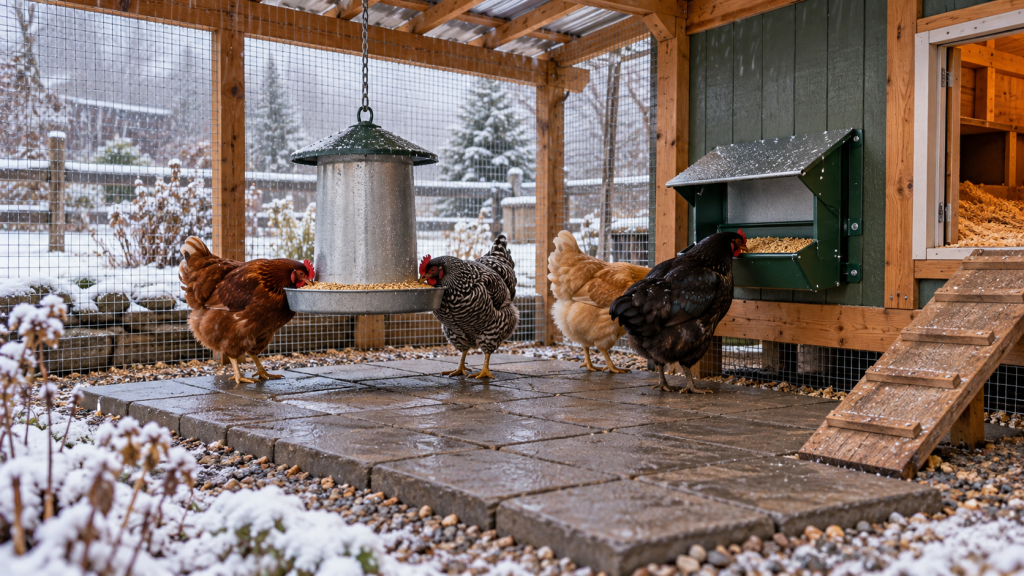
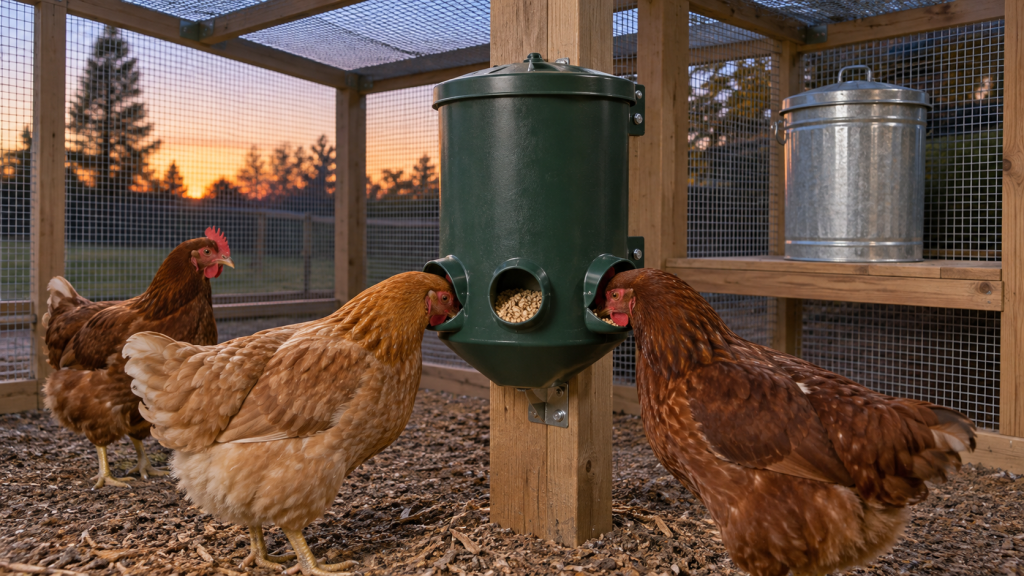
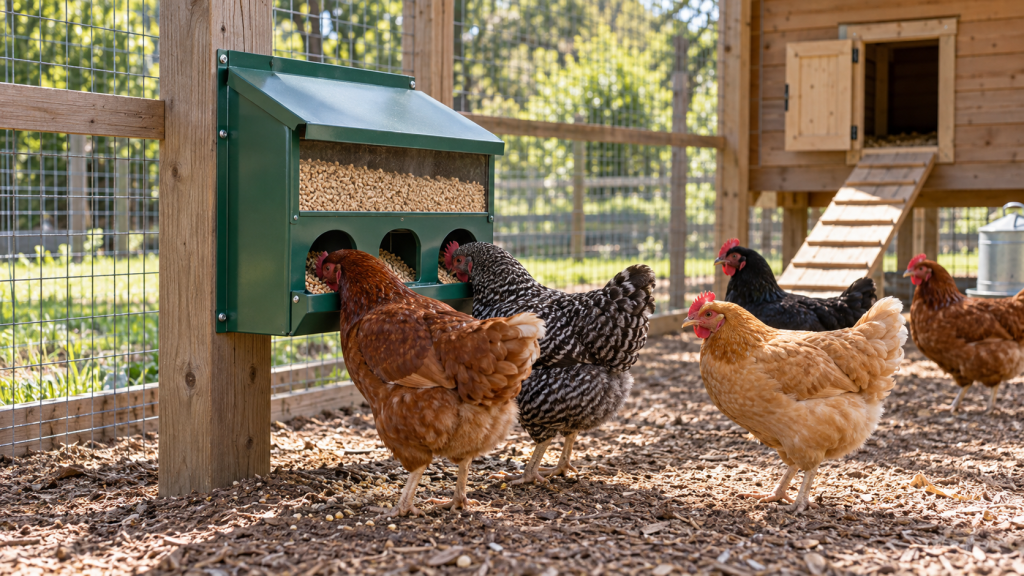
Most small flocks need at least one well-sized feeder, but two separated feeding stations are often safer once you have more than a few hens, mixed sizes, or a strong pecking order. Hopper capacity tells you how often to refill; it does not tell you whether every bird can eat.
Start with daily feed demand
Many adult laying hens consume roughly a quarter pound of complete feed daily, but real intake changes with breed, size, weather, production, forage, and feed density. Measure your own flock for a week. A feeder should hold the amount needed between inspections with enough headroom for feed to flow freely.
| Flock | Approximate daily amount | Suggested arrangement |
|---|---|---|
| 3–4 hens | 0.75–1 lb | One covered feeder; consider a small backup |
| 5–8 hens | 1.25–2 lb | One medium feeder or two access points |
| 9–12 hens | 2.25–3 lb | Two separated stations are often useful |
| 13–20 hens | 3.25–5 lb | Multiple stations with generous access |
These are planning estimates, not ration limits. Check the chicken feeding guide for age-appropriate nutrition.

Count feeding positions, not just pounds
A 20-pound hopper with one narrow opening is still one social bottleneck. Watch a normal morning meal. Can a timid hen approach, eat, and leave without being displaced? Are birds forming a long queue or reaching over one another? If so, add access rather than simply increasing hopper volume.
When a second feeder is important
- A dominant hen guards the primary feeder.
- You have bantams and standard-size birds together.
- New birds are being integrated.
- The run has separate zones or visual barriers.
- One feeder failure would leave the flock without food.
- A sick or injured bird needs a quiet station.
Place the second station far enough away that one bird cannot defend both at once, ideally with a sight barrier between them.

Adjust for feeder design
Round hanging pans offer perimeter access, while port feeders have a fixed number of openings. A treadle feeder may expose a long trough but usually operates for one or a few birds at a time. Review the choices in our chicken feeder guide and treadle vs. gravity comparison.
A simple seven-day test
- Mark or weigh the morning feed amount.
- Watch the flock at first feeding and late afternoon.
- Note waiting, guarding, chasing, and birds eating only after others leave.
- Check crops and body condition, especially on lower-ranking birds.
- Add a temporary second station and compare behavior.
If competition falls and previously excluded birds eat calmly, the extra station is useful even if the original hopper had enough capacity.

Special flock situations
Chicks
Use low, stable chick feeders with enough openings that growing birds do not pile on one another. Increase space as they grow and keep the trough free of wet bedding and droppings. The chick brooder setup guide covers the larger environment.
Bantams and mixed sizes
Set height for the smallest bird and confirm ports are large enough without allowing birds to climb inside. Separate stations can work better than compromising one feeder for every size.
Newly integrated birds
Provide more stations than usual during the transition. Put them in different zones with visual separation, then reduce only after every bird eats without being chased.
Capacity, refill interval, and reserve
Multiply measured daily use by the days between refills, then add modest headroom. Six hens eating 1.5 pounds daily need more than a three-pound hopper for a two-day interval. Even then, check daily for bridging, moisture, contamination, or a blocked opening. Keep a clean backup feeder ready because hardware can fail or freeze.
Signs you need more access now
- One bird repeatedly patrols the feeder.
- Hens stretch over one another or form a long queue.
- A lower-ranking bird’s crop is routinely empty late in the day.
- Feed remains while some birds lose condition.
- A temporary second pan immediately calms the flock.
Correct the bottleneck before restricting openings to reduce waste.
Seasonal adjustments
Consumption and access patterns change. Cold weather can increase energy demand, summer heat may reduce daytime eating, and short days compress activity into fewer hours. Recheck feeder capacity and competition whenever weather, flock size, housing, or feed type changes. The number that worked in spring may not be adequate after new pullets join the flock.
The short answer by flock size
A peaceful flock of four adult hens may use one properly sized feeder. Six to eight hens often benefit from two access points, especially when the feeder has ports rather than a full circular pan. For nine or more hens, two separated stations provide useful social access and backup even when one hopper holds enough feed.
These are practical starting points, not universal limits. Feeder type, usable eating edge, breed size, pecking order, and the manufacturer’s rated bird count can change the answer. Calculate both feed capacity and simultaneous access, then use the larger requirement.
| Adult flock | Linear space using 3 in./bird | Practical starting arrangement |
|---|---|---|
| 4 hens | 12 inches | One accessible feeder; keep a backup available |
| 6 hens | 18 inches | One generous pan or two smaller stations |
| 8 hens | 24 inches | Two access points are often useful |
| 10 hens | 30 inches | Two separated feeders or equivalent usable perimeter |
| 12 hens | 36 inches | Two or more stations, adjusted for flock behavior |
| 20 hens | 60 inches | Multiple stations in separate areas |
Use three calculations, not one
1. Daily feed requirement
For planning, many adult laying hens consume about one-quarter pound of complete feed daily. Multiply flock size by 0.25 pound, then by the number of days you want the hopper to hold. Add modest headroom so feed flows without packing against the lid.
Example: 10 hens × 0.25 pound × 2 days = 5 pounds. With roughly 20 percent headroom, look for about 6 pounds of usable capacity. This is an estimate, not a ration limit; measure your flock’s actual use.
2. Eating-space requirement
Multiply the number of birds by the space appropriate to their age and size. Utah State University Extension suggests about one linear inch per chick and two to three inches per adult. Penn State commonly recommends three inches per laying hen. University of Minnesota guidance increases space as pullets grow.
3. Social-access requirement
Ask whether one bird can control the entire resource. A feeder may satisfy the math yet fail socially. When guarding, integration, or mixed sizes are present, add a separate station even if total capacity and inches look adequate.
A useful planning expression is:
Required feeder count = the largest result from capacity, eating-space, or social-access needs.
Feeder-space guidelines by age
| Bird stage | Planning space | Important adjustment |
|---|---|---|
| New chicks | About 1 linear inch per chick | Use a low chick-safe feeder with many openings |
| Chicks around 2 weeks | UMN suggests increasing toward 2 inches | Add or enlarge feeders as chicks grow |
| Growing pullets | UMN suggests 3–4 inches per pullet | Raise height and reassess access frequently |
| Adult laying hens | About 2–3 inches; use 3 inches conservatively | Account for breed size and pecking order |
| Bantams | May need less edge but easier reach | Do not let standards block the lower station |
The 20-inch flip-top chick feeder illustrates why trough length and openings matter for young birds. It should be expanded or supplemented as chicks outgrow the original access.
Calculate usable space for each feeder type
Straight trough
Measure only edges the birds can actually reach. A 24-inch trough against a wall provides 24 inches, not 48. If both sides are safely accessible and the manufacturer intends two-sided use, both may count. Divide usable inches by the chosen inches-per-bird guideline.
Example: a two-sided 24-inch trough offers up to 48 inches of usable edge. At three inches per adult hen, the theoretical capacity is 16 birds. Reduce that number if end caps, dividers, or nearby walls restrict positions.
Round pan
A pan’s circumference is diameter × 3.14, but not every inch is necessarily usable. The center hopper, hanging hardware, wall placement, and crowding reduce access. Use the manufacturer’s rated bird count when available. If calculating, measure the feeding edge and subtract blocked sections rather than relying on the hopper diameter.
Port feeder
Count actual openings. Unless the manufacturer says otherwise and birds demonstrably share, plan on one adult bird per port at a time. Three ports do not become adequate for a large flock merely because the hopper holds several days of feed.
Treadle feeder
Count the birds that can stand securely on the plate and reach the trough together. A wide hopper can still have one operating position. Confirm the lightest bird opens it and keep another station for any hen unable to use the mechanism.
| Feeder | What to count | Common overestimate |
|---|---|---|
| One-sided trough | Reachable linear edge | Counting the wall side |
| Two-sided trough | Both clear edges | Ignoring blocked ends or crowding |
| Round pan | Usable perimeter or manufacturer rating | Counting the full circumference beside a wall |
| Port feeder | Usable ports | Equating hopper pounds with bird positions |
| Treadle | Safe treadle and trough positions | Assuming every bird can activate it |
Capacity examples for common backyard flocks
| Flock | Estimated one-day feed | Two-day capacity with 20% headroom | Access check |
|---|---|---|---|
| 4 hens | About 1 lb | About 2.4 lb | At least 12 usable inches or adequate ports |
| 6 hens | About 1.5 lb | About 3.6 lb | At least 18 usable inches |
| 10 hens | About 2.5 lb | About 6 lb | At least 30 usable inches, usually split |
| 12 hens | About 3 lb | About 7.2 lb | At least 36 usable inches across stations |
| 20 hens | About 5 lb | About 12 lb | At least 60 usable inches in separate areas |
Never use the estimate to restrict a healthy laying flock’s appropriate complete feed. Monitor actual intake, feed condition, and body condition daily.
Where multiple feeders should go
Two feeders placed side by side may function like one resource because a dominant hen can guard both. Separate them by distance, a visual barrier, or different run zones while keeping each under solid cover. Every station needs level footing, protection from droppings and water splash, and a clear exit route.
- Do not put a backup feeder outside the secure run where predators or wild birds can access it.
- Do not place one under a roost, ramp edge, or roof drip line.
- Keep waterers far enough away that splashing cannot dampen feed.
- Make each station visible during daily care.
- Use comparable feed so a dominant bird does not guard the “better” option.
For overall housing and equipment planning, connect the feeding layout with the Backyard Chickens 101 guide.
When one feeder is enough
One feeder may be sufficient when the flock is small and stable, the full eating edge is accessible, no bird guards it, all birds are similar in size and ability, and a clean backup feeder can be installed immediately if the main unit fails. Confirm with observation rather than assuming.
When two or more feeders are safer
- The flock has more birds than can eat comfortably at once.
- Ports or a treadle create limited positions.
- Bantams, standards, seniors, or recovering birds have different access needs.
- New birds are being integrated.
- The run has separate zones and birds spend time far from the main station.
- A mechanical failure would leave no accessible feed.
- Cold weather or short winter daylight compresses feeding into busier periods.
Perform a feeder-access audit
- Observe the flock for 15 minutes after the morning refill.
- Record which birds eat, wait, are displaced, or avoid the station.
- Repeat late in the day when lower-ranking hens may approach.
- Check whether feed remains while any bird has an empty crop or declining condition.
- Add a temporary second station in a separate area.
- Compare queues, chasing, intake, and waste for seven days.
If the flock becomes calmer and previously excluded birds eat reliably, keep the additional station. If behavior does not change, inspect feeder height, feed flow, health, and ration quality rather than adding containers indefinitely.
Plan for growth and emergencies
Buy for the flock you expect to manage, but do not make a huge hopper the only plan. Feed stored in a feeder is exposed to more temperature and humidity change than feed in secure bulk storage. Maintain a clean spare feeder for repairs, quarantine, storms, or a bird that needs separate access.
Recalculate after adding or removing birds, changing feed, replacing a feeder, integrating pullets, or entering extreme weather. Capacity and feeder count are management decisions that change with the flock.
Frequently asked questions
Can all hens eat from one feeder?
Sometimes, especially in a peaceful small flock with generous perimeter space. Behavior is the deciding evidence.
Does a bigger feeder mean fewer inspections?
No. Check feed condition, access, and consumption daily even when the hopper lasts several days.
Where should two feeders go?
Under cover on dry, level surfaces, separated enough that one dominant bird cannot monitor both.