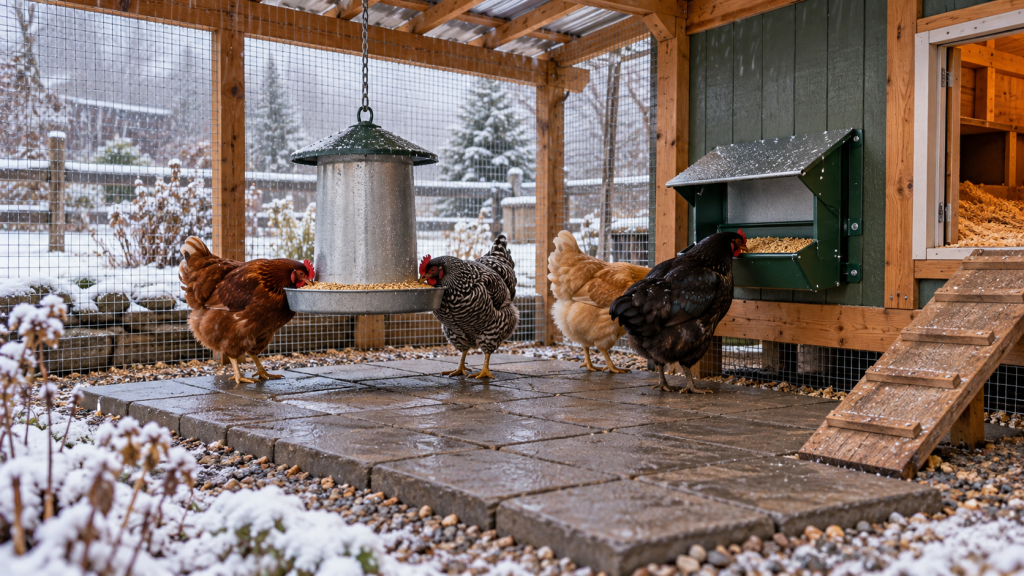
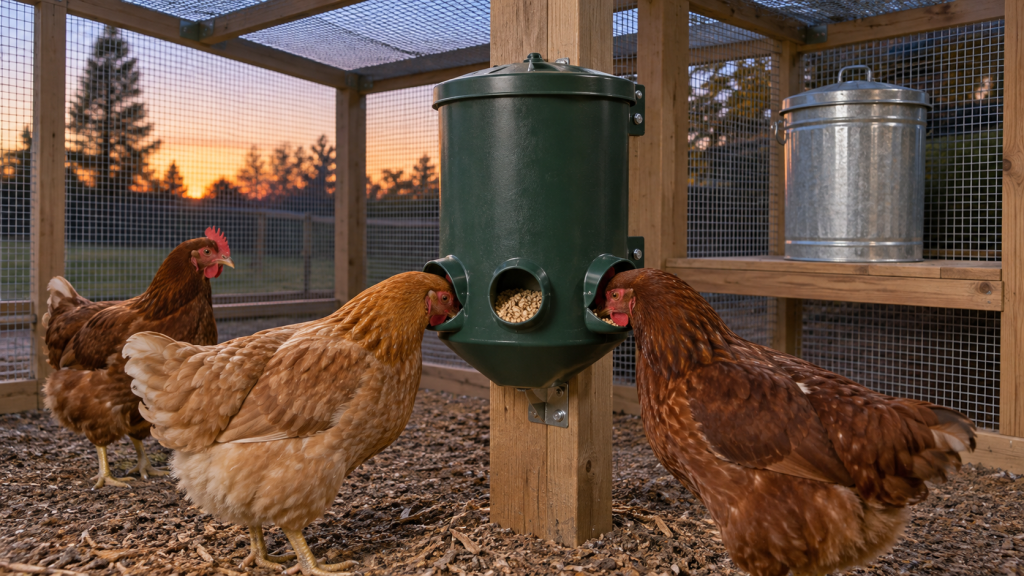
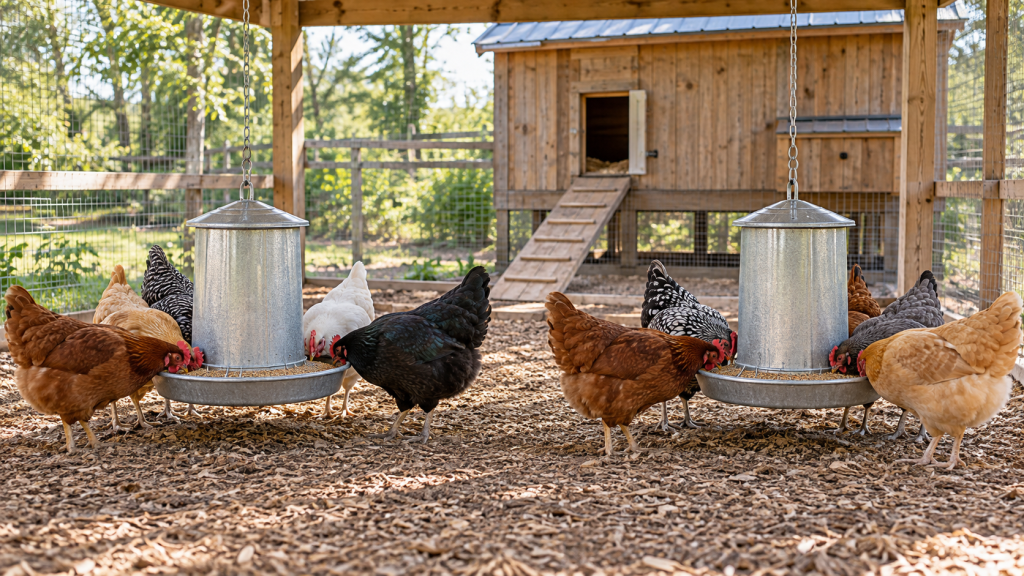
To stop chickens from wasting feed, raise the feeding edge to about back height, keep the feeder level, reduce the fill depth in open pans, and use a lip, grid, or access port that prevents sideways billing. Then watch the flock: spilled feed can come from design, placement, feed texture, crowding, or rodents.
Identify the kind of waste
| What you see | Likely cause | First correction |
|---|---|---|
| Feed swept sideways | Billing with the beak | Use a deeper lip, divider, or port feeder |
| Feed mixed with bedding | Feeder is too low | Raise it to the birds’ back height |
| Whole feeder tipped | Unstable base or chain | Level and secure it |
| Wet clumps below feeder | Rain, splash, or condensation | Move it under solid cover |
| Feed vanishes overnight | Rodents or wildlife | Close access, clean spills, and inspect for entry |

Correct height and placement
For adult hens, start with the feeding lip near back height and adjust for the smallest bird that must use it. The bird should reach comfortably without climbing into the tray. Put the feeder on level pavers or mount it firmly to a post. Keep it away from roost droppings and water splash.
Do not overfill the tray
A deep open layer invites sorting and billing. Fill the hopper, but let the tray replenish at the intended level. If adjustable, follow the manufacturer’s instructions. Empty accumulated fines instead of topping new feed over old residue.
Provide enough access
Frantic scattering can be a crowding problem. Add a second feeding station where a dominant hen cannot control both, especially after flock integration. Our guide to feeder number and eating space explains how to account for pecking order as well as hopper capacity.

Choose the right design
Covered gravity feeders are simple but need the correct height and tray depth. Wall-mounted port feeders reduce scratching and save floor space. Treadle feeders restrict access between visits but require training. Compare them in the complete chicken feeder guide and treadle vs. gravity comparison.
Measure whether the fix works
- Weigh or consistently scoop the feed offered each morning.
- Record what remains before the next refill.
- Check the ground and bedding for pellets or fines.
- Repeat for seven days before and after the change.
A sudden drop in actual consumption can also indicate heat, illness, bullying, or a feed-quality problem. Do not assume every change is “less waste.”

Feed form, fines, and selective eating
Crumbles create more visible fines than intact pellets, while a mixed ration can encourage birds to pick preferred pieces and scatter the rest. The solution is not automatically to change form: chicks and adults have different needs. Use a complete ration intended for the birds’ life stage and seek qualified nutrition advice before a major change.
Let a feeder empty on a normal schedule rather than continually burying fines under fresh feed. Never feed moldy or musty residue. Clean and dry the unit fully before refill.
Separate chicken behavior from pest loss
Bird-made waste usually appears during feeding directly below the tray. Rodent loss may occur overnight with droppings, gnaw marks, tunnels, or greasy rub marks. Wild birds are often visible by day. A camera can help, but sanitation and exclusion should begin immediately. Use our pest-access guide when loss continues after height and fill level are corrected.
Low-cost corrections before replacing a feeder
- Level the base or shorten an overly long hanging chain.
- Raise the pan in small increments while keeping it reachable.
- Move it away from the run edge and waterer.
- Reduce tray depth using only approved adjustments.
- Add a separate station to relieve crowding.
- Repair damaged lids, brackets, and pans promptly.
Photograph the ground at the same time daily and record scoops added for one week. This helps distinguish lower waste from lower appetite during heat or illness.
When waste may signal a health problem
A hen repeatedly dropping feed, missing the tray, or struggling to grasp pellets may have a beak, vision, or neurologic problem. A flock-wide appetite change can accompany heat stress, spoiled feed, or illness. Check the birds and ration before assuming the feeder is at fault, and contact a poultry veterinarian when abnormal behavior or weight loss persists.
Measure waste before changing equipment
Feed that disappears is not automatically feed the hens ate. Establish a baseline for seven days using the same scoop or a kitchen scale. Record feed added, feed remaining at the next refill, visible feed on the ground, weather, and any change in flock size or egg production. Check after dark for rodent activity and during the day for wild birds.
A simple estimate is:
Feed offered − usable feed remaining = feed removed from the feeder.
That result includes consumption, spills, pests, and spoiled feed. It becomes useful when paired with observation. Photograph the ground beneath the feeder from the same angle each day and note whether the particles are intact pellets, fine powder, damp clumps, or a broad scratch pattern.
| Evidence | Most likely source | What to inspect next |
|---|---|---|
| Intact feed directly below the lip | Billing or an overfilled tray | Feeder height, exposed depth, and lip design |
| Feed spread through bedding | Scratching or feeder mounted too low | Height, stability, and birds standing in the tray |
| Damp clumps after weather | Roof runoff, splashback, or condensation | Shelter, ground drainage, and lid interior |
| Feed disappears mainly overnight | Rodents or another animal | Droppings, gnawing, tunnels, camera footage, and access gaps |
| Fine powder accumulates in the hopper | Feed breakdown, sorting, or poor flow | Feed age, handling, outlet setting, and feeder compatibility |
Set feeder height and tray depth correctly
For adult chickens, start with the feeding lip around back height. Utah State University Extension describes positioning a raised feeder around the mid-to-upper breast region; Penn State guidance uses back height. The bird should reach comfortably while standing on the ground, but she should not be able to step into the tray or rake bedding into it.
Raise the feeder in small increments and observe the shortest bird. For a hanging feeder, use a secure chain attached to structural framing and keep the pan level. For a wall-mounted unit, fasten the bracket to a rigid post or wall rather than flexible wire fencing.
Do not keep an open trough filled to the rim. Penn State sources recommend limiting exposed feed depth—guidance ranges from roughly one-third to two-thirds full depending on the feeder and publication—to reduce billing and spills. Follow the feeder’s instructions when it controls tray depth automatically.
Provide enough eating space
Competition can look like waste. A bird that is repeatedly displaced may snatch and fling feed, while dominant hens can crowd the tray. Utah State suggests about two to three linear inches of feeder space per adult chicken, and Penn State commonly recommends three inches. Ports and treadles should be judged by actual usable positions, not hopper capacity.
| Observation | Meaning | Correction |
|---|---|---|
| Birds eat calmly around the tray | Access is probably adequate | Continue monitoring |
| Long queue at peak feeding | Too few positions | Add another station |
| One hen patrols the feeder | Social guarding | Place a second feeder out of her sightline |
| Small hens reach over larger birds | Mixed-size access problem | Use a separate height-appropriate station |
| Feed remains while a bird loses condition | Exclusion, mechanical access, or illness | Provide immediate separate access and assess the bird |
Match the feeder to the feed form
Round tube feeders generally work well with pellets and crumbles because the ration flows as birds eat. Mash and fine material can bridge or pack in some hopper outlets. University of Minnesota Extension notes that open trough designs with inward-curving sides can reduce spillage and handle mash more reliably than some tubular feeders.
Do not choose feed solely by how clean the ground looks. Chicks, pullets, laying hens, broilers, and breeding birds require appropriate complete rations. Changing from crumble to pellet or mash to solve mess can be harmful if the replacement is not formulated for the flock’s age and purpose. The chicken feeding guide explains those nutritional stages.
Manage fines without hiding them
Let the feeder approach empty on its normal schedule so fines can be seen and removed. Continually topping new feed over old powder lets stale or damp material accumulate. If a new bag contains unusually high fines, document the lot information and contact the feed supplier rather than sifting out nutrients or inventing a homemade ration.
Use feeder design to limit specific behaviors
| Waste problem | Useful design feature | Tradeoff |
|---|---|---|
| Birds sweep feed sideways | Deep inward lip, grid, or access port | May reduce simultaneous access |
| Birds scratch bedding into feed | Raised or wall-mounted feeder | Must remain reachable to the smallest bird |
| Wildlife eats from an open pan | Controlled-access treadle lid | Requires adult birds, training, and maintenance |
| Feeder tips or swings | Stable base or two-point restraint | Installation must still allow cleaning |
| Feed gets wet | Rain hood and sheltered placement | A hood cannot stop all wind-driven rain |
The 5 lb VFeedr wall-mounted feeder illustrates a raised, limited-access design for a small flock or second station. A product feature should match the diagnosed problem; replacing an open pan will not solve a leaking roof or an unchecked rodent entry point.
Separate feed waste from storage loss
Feed can be lost before it reaches the feeder. Torn bags, loose lids, damp storage rooms, insects, and repeated scooping from the floor all add cost. Keep bulk feed in a clean, dry container with a tightly fitted lid, rotate older feed first, and store the scoop where it stays clean. Review safe chicken-feed storage before blaming the feeder for every loss.
Do not put feed swept from the ground back into the hopper. It may contain droppings, bedding, moisture, mold spores, or pest contamination. Correcting the source is safer than trying to recover questionable ration.
Calculate what waste costs
Use your actual delivered feed price. Divide the bag cost by its weight to find cost per pound, then multiply by the estimated pounds wasted each week.
Example formula: bag price ÷ bag pounds × pounds wasted weekly = weekly waste cost.
If a 40-pound bag costs $24, feed costs $0.60 per pound. Losing two pounds weekly costs about $1.20 per week or roughly $62 per year. This example is only arithmetic; substitute current local prices and measured waste. Include the cost of replacement parts or a new feeder before assuming an upgrade will pay for itself.
A seven-day correction plan
- Day 1: photograph the site, measure feed, and identify whether loss occurs by day or night.
- Day 2: level and secure the feeder; correct obvious roof or waterer splash.
- Day 3: adjust the lip to adult back height while protecting access for smaller birds.
- Day 4: reduce exposed tray depth according to the feeder directions.
- Day 5: watch peak feeding for queues, guarding, or birds standing in feed.
- Day 6: add a temporary second station if competition is present.
- Day 7: compare feed used, visible waste, access, body condition, and egg production with the baseline.
Change one major variable at a time when possible. If height, feed form, location, and feeder design all change together, you will not know which correction worked.
When the feeder is not the real problem
A sudden appetite change, repeated dropping of feed from the beak, difficulty aiming at the tray, lethargy, weight loss, or reduced egg production can signal illness, injury, dental or beak damage, vision trouble, or heat stress. Provide easy access to fresh feed and water and evaluate the bird. Persistent or severe signs warrant advice from a poultry veterinarian.
Likewise, emptying a feeder faster during cold weather or after adding birds may be normal consumption rather than waste. Recalculate flock demand whenever the season, flock size, feed, or production stage changes.
Frequently asked questions
Are pellets less wasteful than crumbles?
Sometimes, but the right form depends on bird age and the complete ration. Never switch solely to reduce mess without confirming the feed is appropriate.
Should I feed spilled feed back to the flock?
No if it is wet, moldy, contaminated with droppings, or exposed to pests. Preventing the spill is safer than salvaging questionable feed.
Will a no-waste feeder stop all loss?
No. It reduces common behaviors, but damage, poor placement, crowding, and pests can still cause loss.