A gravity feeder is usually the simplest choice; a treadle feeder is often better when rodents, wild birds, or overnight feed access are persistent problems. The better option depends on whether you value immediate access and easy monitoring or controlled access and greater pest resistance.
Both styles can work well when they are dry, stable, correctly sized, and accessible to every hen. For an overview of all designs, placement, and sizing, begin with our chicken feeder guide.
Treadle feeder vs. gravity feeder at a glance
| Question | Treadle feeder | Gravity feeder |
|---|---|---|
| Learning curve | Birds need gradual training | Usually immediate |
| Pest access | Closed when no trained bird is present | Feed tray remains open |
| Flock fit | Best for healthy birds heavy enough to operate it | Works for a wider range of ages and sizes |
| Maintenance | Linkages and settings need inspection | Hanger, lid, and tray need inspection |
| Cost | Higher initial cost | Usually lower |
| Weather | Covered, but still needs shelter and level ground | Needs solid cover from rain and snow |

When a treadle feeder makes sense
Choose a treadle feeder when adult birds are physically able to operate it and open feed is attracting unwanted visitors. A correctly adjusted lid stays closed between meals, which can reduce exposure to rodents, wild birds, rain splash, and wind. The unit still needs a sheltered, level location, and spills must be removed.
Treadle feeders are not ideal for tiny chicks, birds with mobility problems, or a mixed group whose lightest member cannot reliably activate the pedal. They also require patience. Keep the old feeder available until you have personally seen every bird use the new one; use our step-by-step treadle training plan.
When a gravity feeder is the better choice
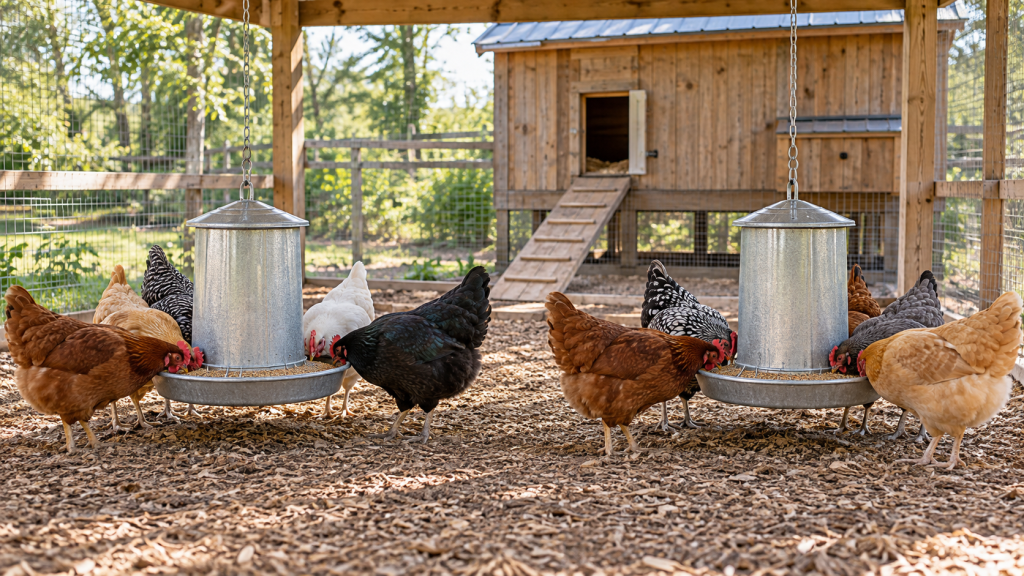
A hanging or raised gravity feeder offers simple, visible access. It is often best for a secure run, a flock with varied body sizes, or a keeper who wants minimal moving parts. It is also easier to use as a second station when pecking-order pressure is a concern.
The tradeoff is that an open pan does not distinguish a hen from a mouse or wild bird. Hang the feeder at adult back height, keep it under cover, remove spills, and do not leave it accessible overnight where pest pressure is high.

Decision guide
- Choose treadle if pest access is the main problem, all birds are mature and mobile, and you can supervise training.
- Choose gravity if simplicity, mixed bird sizes, and multiple open access points matter most.
- Use both during transition, or keep a small backup station available for a timid or injured bird.
Whichever you select, capacity does not guarantee adequate access. Read how many feeders your flock needs, then monitor for guarding and displaced hens.

Cost, maintenance, and safety
A gravity feeder usually costs less upfront and has few moving parts. A treadle feeder costs more, but reduced wildlife access and less overnight exposure may repay part of that difference where losses are significant. Measure feed purchased, feed remaining, and visible spills before and after a change rather than guessing from hopper size.
Inspect galvanized components for sharp edges and binding. Check plastic for UV cracking and damaged mounting points. For either design, keep feed away from water splash and roost droppings. Test a treadle’s entire pedal-to-lid cycle by hand before birds enter, and confirm the lightest hen can operate it without struggling.
Best choice by common scenario
Secure covered run with little pest pressure
A hanging gravity feeder is usually efficient and economical. Raise it correctly and provide enough tray space.
Persistent wild-bird visits
A trained adult flock may benefit from a treadle feeder combined with physical exclusion. Spilled feed can still attract visitors.
Mixed bantams and standard hens
A gravity feeder or several port feeders may provide more reliable access. If using a treadle, verify the smallest bird meets the operating-weight requirement.
Long refill interval
Choose capacity with margin, but arrange a responsible person to inspect birds and feed daily. A large hopper does not make a flock self-monitoring.
How the two feeder systems work
Gravity feeder mechanics
A gravity feeder stores feed above the eating tray. As chickens remove pellets or crumbles, more ration slides through the outlet. There is no access control: any chicken, rodent, or wild bird that reaches the pan can eat. The simplicity is useful because you can see the feed level and recognize a blockage quickly, but flow depends on dry feed, a level hopper, and an outlet adjusted for the feed texture.
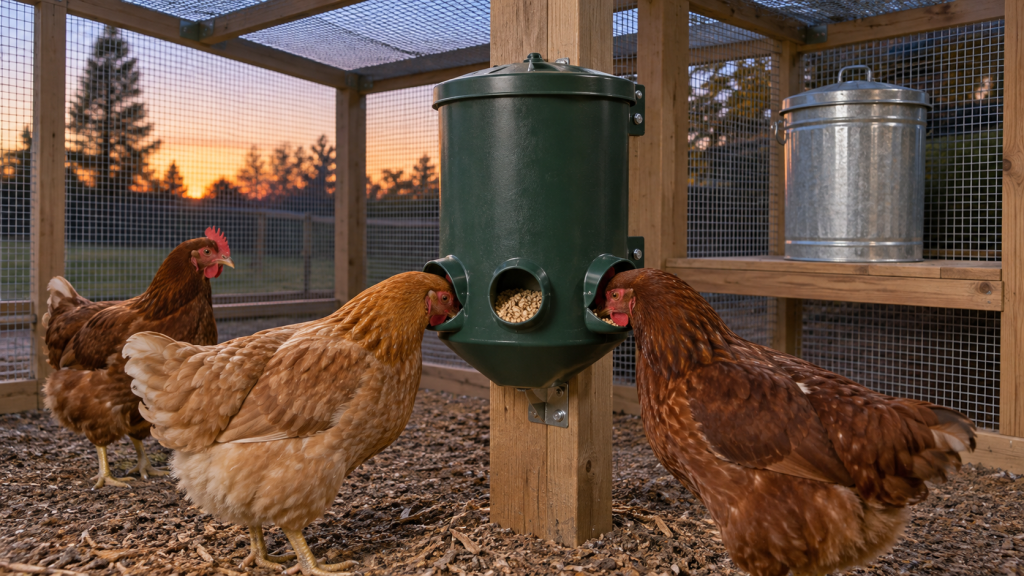
Round hanging feeders distribute birds around the pan. Raised floor models work similarly but rest on a stable base. Wall-mounted gravity designs save floor space and may restrict billing with ports or a deep lip. In every case, the word “gravity” describes feed delivery—not weather resistance or pest exclusion.
Treadle feeder mechanics
A treadle feeder adds a weight-operated access system. When a chicken stands on the pedal, linkage arms lift or release the lid over the trough. When the bird steps away, the cover closes. The useful feature is not automatic dispensing; it is that the ration is normally unavailable when no trained chicken is present.
The pedal, hinges, counterweight, linkage, and lid must operate as one system. Placing an improvised block under the lid after training, changing springs outside the instructions, or letting debris accumulate can defeat the access control. A treadle feeder should sit on a firm level base so the pedal moves through its intended range.
Compare feeding access, not just hopper capacity
Utah State University Extension recommends roughly two to three linear inches of feeder space per adult chicken, while Penn State Extension uses three inches per laying hen. A round gravity pan may provide access around most of its perimeter. A treadle trough may permit one, two, or several birds depending on its width and pedal design.
| Access question | Gravity feeder | Treadle feeder |
|---|---|---|
| Can many hens eat together? | Often, especially around a circular pan | Depends on treadle and trough width |
| Can one hen guard it? | Harder with full perimeter access | Easier if there is one narrow approach |
| Can bantams use it? | Usually, when height is adjusted | Only if they meet the operating weight |
| Can an injured hen use it? | Often easier to approach | May be difficult or unsafe |
| Does a full hopper guarantee access? | No | No |
Watch the flock during its busiest meal. A feeder is undersized if birds queue, reach over one another, or displace the same timid hen repeatedly. The answer may be a second station rather than a larger hopper. Place stations far enough apart that one dominant bird cannot control both.
Pest resistance: what each feeder can and cannot do
An open gravity pan gives rodents and wild birds direct access whenever they enter the feeding area. Bringing the unit inside at dusk or emptying it can help, but spilled feed may remain. A treadle feeder closes the trough between chicken visits, removing a major food reward. It does not seal the entire site or replace sanitation.
Rats may learn to exploit a pedal that is set too lightly, and mice may reach spilled feed below either design. Wild birds can enter while chickens hold a lid open. Use intact hardware cloth, secure doors, sealed bulk storage, and prompt cleanup alongside the feeder. If pest evidence continues, work through our guide to keeping rodents and wild birds out of chicken feeders.
Which design prevents more feed waste?
A treadle feeder can reduce feed lost to wildlife and protect the trough between visits. A gravity feeder can still be efficient when the pan is kept at back height, the exposed feed depth is limited, and the lip prevents sideways billing. Feed form matters: fines and certain mixed rations are easier for birds to sort and scatter than intact pellets or crumbles.
Measure before deciding. Use the same scoop for seven days, record feed added, photograph the ground below the feeder, and note nighttime pest signs. Repeat after the change. Lower feed use is only a success if egg production, body condition, and access remain normal. See how to stop chickens from wasting feed for a symptom-based checklist.
Rain, snow, and wind exposure
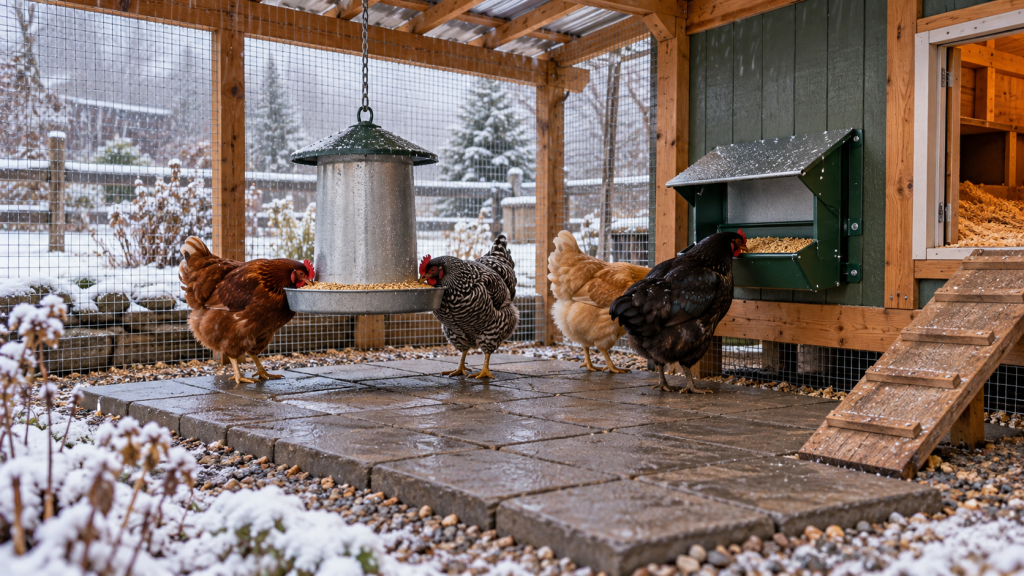
Neither design belongs in an unsheltered location. A treadle lid helps cover the trough, but wind-driven rain can enter from the front, snow can block the pedal, and ice can interfere with the linkage. A gravity feeder’s lid protects the hopper while leaving the pan exposed to splash and drifting snow. Hanging models can swing in high wind and spill.
| Weather risk | Treadle response | Gravity response |
|---|---|---|
| Wind-driven rain | Move farther inside roof line; inspect trough corners | Move inward; protect the open pan from splash |
| Snow and ice | Clear pedal, hinges, and closing path | Clear tray and keep chain or base stable |
| Summer sun | Shade metal surfaces and ration | Shade hopper and avoid long storage intervals |
| Humidity | Check under lid and in bottom seams | Check for bridging and condensation |
For a complete placement routine, use how to keep chicken feed dry outdoors.
Installation and transition requirements
Installing a gravity feeder
- Choose solid shelter and a level location.
- Attach a hanging chain to structural framing or prepare a stable raised base.
- Set the pan near adult back height and confirm the smallest bird can reach.
- Fill partly and verify feed flows without flooding the tray.
- Watch for swinging, tipping, and birds climbing into the pan.
Installing a treadle feeder
- Assemble the mechanism exactly as directed.
- Place the unit on level pavers with clearance for the pedal and lid.
- Operate the pedal by hand and inspect every hinge and linkage.
- Set the approved training position with the lid fully open.
- Keep the previous feeder available until every hen completes the training sequence.
The changeover may take days rather than hours. Follow our treadle-feeder training plan and never withhold feed to force participation.
Cleaning and maintenance comparison
| Task | Gravity feeder | Treadle feeder |
|---|---|---|
| Daily | Check pan, flow, hanger or base, and feed condition | Check trough, closure, pedal movement, and feed condition |
| Weekly | Remove fines; inspect lid, chain, and outlet | Remove fines; inspect hinges, linkage, lid, and adjustment |
| Washing | Disassemble as directed and dry completely | Keep cleaner out of inaccessible mechanisms; dry completely |
| Seasonal | Recheck height, shelter, and UV or rust damage | Recheck training, weight setting, shelter, and corrosion |
A simple feeder is not maintenance-free, and a covered feeder does not make damp feed safe. Discard ration that is moldy, musty, pest-contaminated, or wet.
Compare total ownership cost
The purchase price is only one part of the decision. Include a safe stand or hanging hardware, roof improvements, replacement parts, cleaning time, and any feed loss. A less expensive feeder that spills daily can cost more over its life; a costly treadle that half the flock cannot operate is also poor value.
| Cost factor | Questions to ask |
|---|---|
| Purchase and shipping | Is the capacity appropriate, or are you paying for unused size? |
| Installation | Do you need pavers, framing, chain, or a roof extension? |
| Feed loss | Is loss caused by birds, weather, or wildlife? |
| Maintenance | Are parts, instructions, and warranty support available? |
| Backup access | Will you need a second feeder for timid or recovering birds? |
For a product-specific perspective, read our Grandpa’s Chicken Feeder review. Product examples help illustrate features, but the flock’s weight range, social dynamics, and feeding station should determine the choice.
Final decision checklist
- Choose gravity when uncomplicated access, multiple eating positions, mixed bird sizes, and easy visual monitoring are the priorities.
- Choose treadle when healthy adult birds can operate it and reducing rodent or wild-bird access is the primary problem.
- Choose a wall-mounted port feeder when floor space and billing-out matter more than closing access completely.
- Use two feeder types when a mixed or recovering flock cannot safely rely on one mechanism.
- Delay the purchase if the real problem is roof runoff, inadequate feed storage, or a structural pest opening. Correct the site first.
A feeder succeeds when every intended bird eats calmly, the ration remains clean and dry, and daily inspection is easy. The best model is the one that meets those conditions in your actual coop—not the one with the longest feature list.
Frequently asked questions
Will a treadle feeder stop all rats?
No. It reduces open access, but rats can exploit spilled feed, damaged parts, poor adjustment, or structural gaps. Combine it with the controls in our rodent and wild-bird feeder guide.
Can bantams use a treadle feeder?
Some can, depending on body weight and the manufacturer’s adjustment range. Never defeat safety features or improvise a setting the instructions do not support.
Which feeder wastes less?
Either can be efficient. A treadle closes between meals, while a properly raised gravity feeder with a deep lip can also perform well. Diagnose the behavior with our feed-waste checklist.