A good chicken feeder keeps a complete ration clean, dry, and available to every bird without turning the run into an all-day buffet for rodents and wild birds. For most backyard flocks, the best setup is a covered feeder sized for at least one day of feed, placed at adult hens’ back height under a roof, plus a second feeding station when flock dynamics or distance makes one feeder a bottleneck.
This chicken feeder guide explains how the main designs work, how to estimate capacity and eating space, where to put a feeder, and how to prevent waste. Feeder choice matters, but it cannot compensate for spoiled feed, an unbalanced ration, or poor sanitation. Start with our complete chicken feeding guide if you need help choosing feed for a bird’s age and purpose.
Quick chicken feeder comparison
| Feeder type | Best for | Main advantage | Main limitation |
|---|---|---|---|
| Hanging gravity feeder | Most enclosed coops and runs | Simple, visible, and easy to refill | Open feed may attract pests |
| Treadle feeder | Adult flocks with rodent or wild-bird pressure | Feed access is closed between visits | Requires training and careful setup |
| Wall-mounted no-waste feeder | Small runs and birds that bill feed out | Uses little floor space and limits raking | Access ports can create competition |
| Open trough | Brooders and supervised feeding | Many chicks can eat at once | Easy to soil or spill if uncovered |
| Hanging cup | Treats, supplements, quarantine, or a backup station | Flexible and easy to relocate | Too small for a whole flock’s daily ration |

Choose the feeder type by the problem you need to solve
Gravity feeders: dependable and easy to monitor
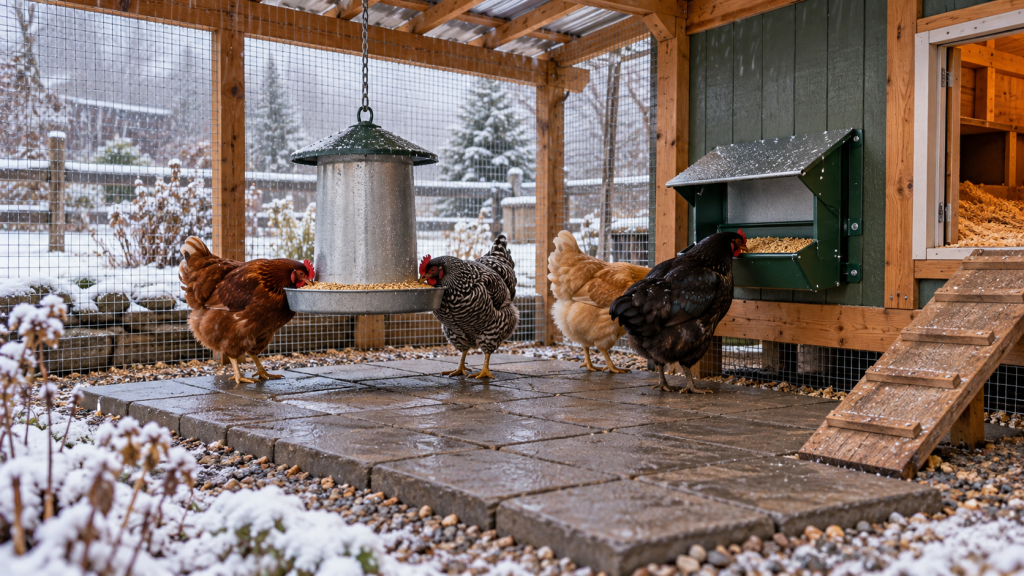
A gravity feeder stores feed in a hopper and replenishes a tray as hens eat. It is usually the easiest design for a new keeper because the feed level and access are obvious. Hang it from a secure overhead point or place it on a stable raised base. The feeding lip should sit roughly level with the backs of the birds using it—not so high that small hens cannot reach and not so low that birds scratch bedding into the pan.
Treadle feeders: controlled access
A treadle feeder opens when a chicken steps on a weighted pedal. It can reduce access by rodents and wild birds, but no feeder is automatically pest-proof. The unit must be stable, adjusted for the birds’ weight, closed cleanly, and used with prompt spill cleanup. Chicks should use a chick-safe feeder, not an adult treadle mechanism. If this style fits your flock, follow our gradual plan for training chickens to use a treadle feeder.
Wall-mounted and port feeders: less floor clutter
Mounting a feeder keeps it away from bedding and preserves run space. Ports or narrow access lips can also make it harder for hens to rake feed sideways. The 5 lb VFeedr wall-mounted feeder is a practical example for smaller flocks or a second station.

How much feeder capacity does a flock need?
Adult laying hens often eat roughly a quarter pound of complete feed per bird per day, but breed, body size, weather, production, forage, and feed density all change consumption. Use actual flock intake, not a rigid number. Multiply the amount your birds normally eat by the number of days you want between refills, then leave headroom so the hopper is not packed to the lid.
| Flock size | Approximate one-day feed | Practical minimum approach |
|---|---|---|
| 4 hens | About 1 lb | One small covered feeder; inspect daily |
| 6 hens | About 1.5 lb | One 5 lb-class feeder or two small stations |
| 10 hens | About 2.5 lb | One larger feeder or two separated feeders |
| 20 hens | About 5 lb | Multiple access points and reserve capacity |
Capacity is not the same as access. One large hopper can still let dominant birds guard the only opening. See how many chicken feeders a flock needs for a method that accounts for body size, feeder openings, and pecking order.

Where to place a chicken feeder
- Under solid cover: keep it inside the roof’s drip line, away from wind-driven rain and roof runoff.
- On a dry, level surface: pavers or a solid platform reduce tipping, mud, and splashback.
- At the correct height: raise an open pan to approximately back height for the birds using it.
- Away from roosts: never place feed where droppings fall into it overnight.
- Where you can inspect it: daily visibility matters more than hiding a feeder in an inconvenient corner.
- With escape space: timid birds need to approach and leave without being trapped by a dominant hen.
For exposed setups, use the detailed checklist in how to keep chicken feed dry outdoors.
Seven ways to prevent feed waste
- Set the feeding lip at a useful height for the smallest bird in the group.
- Do not fill an open pan to the brim; hens can bill and rake a shallow layer more easily.
- Use a lip, divider, grid, or port that limits sideways head movement.
- Keep the feeder level and secure it against swinging or tipping.
- Clean spilled feed promptly instead of letting the flock “finish it later.”
- Offer a second station when crowding causes frantic eating or guarding.
- Measure use for a week so unexplained changes are noticed early.
If pellets or crumbles are collecting under the feeder, diagnose the pattern with our guide to stopping chickens from wasting feed.

Feed safety and pest control
Discard feed that smells musty, looks clumped, feels damp, or shows mold or pest contamination. Washing a feeder is only useful if it dries completely before refill. Store the bulk ration separately in a tightly closed container and rotate older feed first; our feed storage guide covers moisture, mold, and pantry pests.
At night, remove open feed or close controlled-access feeders according to the manufacturer’s instructions. Seal structural gaps, repair hardware cloth, trim hiding cover, and clean spills. Our dedicated guide explains how to keep rats, mice, and wild birds out of chicken feeders, while rat and mouse control around the coop addresses the larger site.

Daily and weekly feeder checklist
Every day
- Confirm every bird can reach feed and that timid birds are eating.
- Check for moisture, droppings, insects, gnaw marks, and spilled feed.
- Verify hangers, brackets, lids, and treadle linkages remain secure.
- Note a sudden change in consumption; it can signal heat, illness, a leak, or wildlife access.
Every week
- Empty fines and stale residue rather than continually topping off.
- Clean as the feeder material and manufacturer direct; dry completely.
- Inspect the shelter and ground for new water paths or pest entry points.
- Compare feed used with flock size and egg production.
Chicken feeder types in more detail
Feeder names can be confusing because capacity, access style, and mounting method are separate features. A “hanging feeder” usually describes how a gravity hopper is installed. A “no-waste feeder” describes a design goal, not a guarantee. Before comparing prices, identify how the birds reach the feed, how the hopper closes, where water can enter, and how the unit will be cleaned.
Round hanging or raised hopper feeders
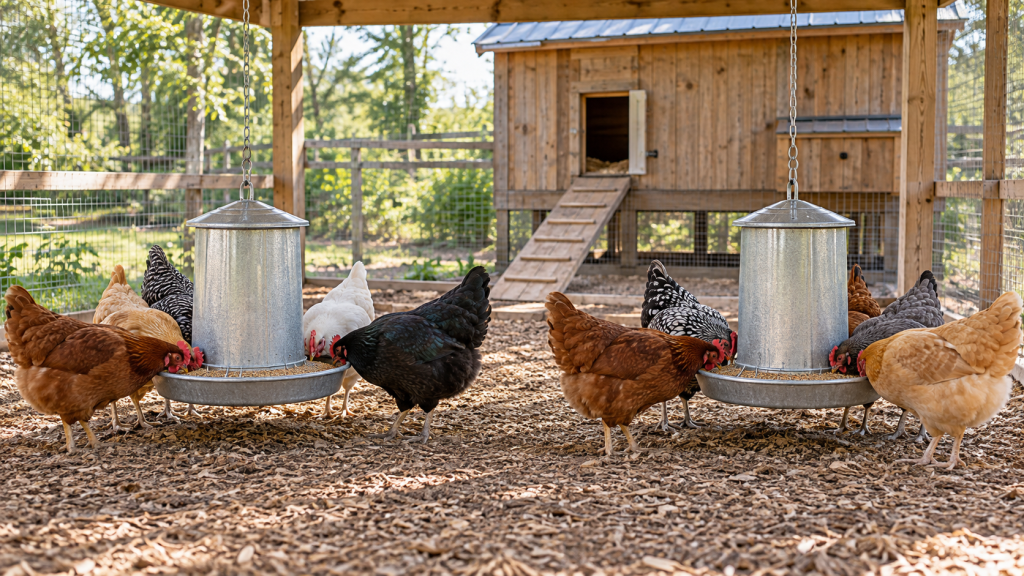
A center hopper replenishes a circular pan. Because birds can stand around much of the perimeter, this style offers more simultaneous access than its footprint suggests. It works best with pellets or crumbles that flow freely. Select a pan deep enough for adult birds, keep it only partly filled at the lip, and raise it as the flock grows. A chain should attach to a structural support—not wire mesh—and the feeder should hang level without swinging into a wall.
Long trough feeders
A trough gives predictable linear eating space and is especially useful for chicks and growing pullets. A flip-top bar or grid discourages birds from stepping into the ration. Choose openings sized for the birds using it; an adult opening can be unsafe or impractical for a tiny chick. Troughs are easy to inspect but hold less reserve feed and need frequent cleaning.
Port and wall-mounted feeders
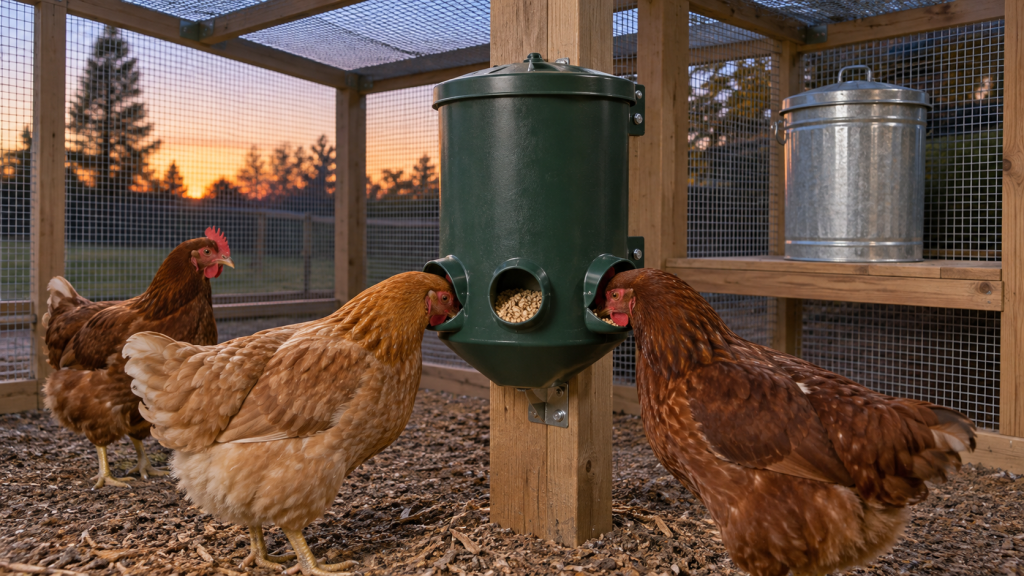
Access ports limit the sweeping head motion that sends feed onto the ground. Wall mounting also removes a trip hazard and keeps bedding away from the feed. The tradeoff is a fixed number of eating positions. Count usable ports and watch whether a dominant hen can guard them. Mount the body to solid framing at the height recommended for the flock, not to flexible fencing that bends under weight.
Treadle and other controlled-access feeders
A bird’s weight on the treadle lifts or releases the feed cover. This protects the trough between visits, but success depends on a stable base, correct weight adjustment, gradual training, and a closing action that remains unobstructed. It is a poor choice for birds that are too light, injured, visually impaired, or unable to balance on the plate. Read our Grandpa’s Feeder review for a long-form look at one commercial treadle design.
Small cups and supplemental feeders
A hanging cup is useful for oyster shell, grit, treats, quarantine, or a temporary second station. Keep supplements separate so hens can choose what they need without diluting the complete ration. A cup’s labeled volume does not make it large enough for a whole flock’s daily feed.
Calculate capacity without overbuying
Use measured consumption whenever possible. For a planning estimate, many adult laying hens eat around one-quarter pound of complete feed per day. Multiply the number of birds by 0.25 pound, then multiply by the days of storage you want inside the feeder. Add about 20 percent headroom so feed can flow and the lid closes without compression.
Example: eight hens × 0.25 pound × two days = four pounds. Adding 20 percent gives a practical hopper target of about 4.8 pounds, so a five-pound feeder is a reasonable starting point. A larger hopper may reduce refills, but it also keeps feed exposed to heat, humidity, and staleness longer.
| Flock example | Estimated daily feed | Two-day amount with 20% headroom | What to verify |
|---|---|---|---|
| 4 adult hens | About 1 lb | About 2.4 lb | All birds can use the access opening |
| 8 adult hens | About 2 lb | About 4.8 lb | One hen cannot guard the only station |
| 12 adult hens | About 3 lb | About 7.2 lb | Consider two separated feeders |
| 20 adult hens | About 5 lb | About 12 lb | Provide multiple access points and reserve capacity |
This is inventory planning, not a feeding restriction. Breed size, temperature, laying rate, age, forage, and feed density change real consumption. Record how much feed you add and what remains at the same time each day. A sudden change can indicate weather stress, illness, wildlife access, a blocked feeder, or a change in feed palatability.
Calculate feeder space as well as capacity
Utah State University Extension recommends roughly one linear inch of feeder space per chick and two to three linear inches per adult chicken. Penn State Extension uses three inches per laying hen. Treat these as starting points and follow the feeder manufacturer’s rated bird count when it is more conservative.
| Bird group | Planning guideline | Management note |
|---|---|---|
| New chicks | About 1 linear inch per chick | Use a low chick-safe trough or hopper; increase access as they grow |
| Growing pullets | Increase progressively; UMN suggests 3–4 inches for growing pullets | Recheck height and opening size frequently |
| Adult laying hens | About 2–3 linear inches per bird | Use three inches when planning conservatively |
| Port feeder | Count actual usable ports | Add another station if hens queue or are displaced |
| Treadle feeder | Count birds that can stand and eat safely | Capacity does not equal simultaneous access |
For a round pan, manufacturers often provide a rated bird count because usable perimeter varies with pan diameter and hopper shape. Do not convert diameter directly into linear space without considering how much of the rim is blocked by brackets or a wall. Our feeder-number and space guide includes a seven-day test for checking whether the flock needs another station.
Match feeder materials to the location
| Material | Strengths | Watch for |
|---|---|---|
| Galvanized metal | Durable, chew-resistant, and stable | Sharp edges, bent seams, corrosion, and hot surfaces in direct sun |
| UV-resistant plastic | Lightweight, rust-free, and easy to wash | Cracks at handles, ports, brackets, and cold-weather impact |
| DIY pipe or bucket | Custom capacity and low cost | Unsafe edges, poor drainage, inaccessible interiors, or dimensions that trap birds |
A homemade feeder should be as easy to inspect and clean as a commercial one. Avoid adhesives, coatings, or repurposed containers that are not appropriate around feed. Smooth every cut edge, cap openings that can trap a head or foot, and mount the finished unit so it cannot rotate or fall.
Plan the feeding station, not just the feeder
The best feeder performs poorly in the wrong location. Stand in the run during a hard rain and during the busiest morning feeding period. Look for roof drips, splashback, wind direction, congestion, and escape routes. A practical station has solid cover, level footing, enough light for inspection, and a path that lets a lower-ranking bird leave without being cornered.
- Choose a dry zone: stay well inside the roof edge and away from downspouts or melting snow.
- Create a stable base: use level pavers or secure mounting into framing.
- Separate water: keep drinker splash and leaking hoses away from feed.
- Avoid contamination from above: never place a feeder beneath roosts, nest-box perches, or a favorite resting shelf.
- Preserve access: leave room around circular pans and clear approaches to ports or treadles.
- Make cleaning easy: you should be able to remove the feeder without dismantling the run.
If you are still planning the housing layout, our Backyard Chickens 101 guide connects feeding equipment with coop space, water, predator protection, and daily care.
Choose by flock stage and ability
Chicks
Begin with a shallow, chick-safe feeder that makes feed easy to find without allowing chicks to become trapped in the lip. Utah State recommends about one inch of linear space per chick; the University of Minnesota advises increasing space as chicks grow. Keep feed close enough to the brooder’s comfort zone for chicks to find it, but not directly under a heat source where feed and equipment can overheat.
Growing pullets
Reassess feeder height and space every week during rapid growth. A feeder that was comfortable at four weeks can become crowded or too low. Pullets should receive the complete ration appropriate to their growth stage, not adult layer feed simply because an adult feeder has been introduced.
Adult layers
Provide free access to the appropriate complete feed during waking hours, plus separate calcium such as oyster shell when appropriate. Keep supplements in their own container so each hen can regulate intake. Size the feeder for the number and body size of birds, not only the amount the hopper holds.
Mixed, senior, or recovering birds
One mechanism may not suit every bird. Bantams, older hens, or birds recovering from injury may need an easy-access station even when the main flock uses a treadle feeder. Observe actual use and body condition rather than assuming a bird will adapt.
Set up a new feeder without disrupting intake
- Clean and dry the new feeder before use.
- Install it level in its permanent sheltered location.
- Add the flock’s familiar complete feed.
- Keep the former feeder available during the transition.
- Watch every bird eat; do not rely on the flock’s boldest members.
- Measure feed use and inspect the ground for one week.
- Remove the old feeder only after access is calm and consistent.
Gravity and port feeders may require little training, but birds still need time to locate and trust them. A treadle requires the staged process described in how to train chickens to use a treadle feeder. Never use hunger to force a transition.
Cleaning and preventive maintenance
Daily checks should catch moisture, droppings, insects, gnawing, bridging feed, and loose hardware. When cleaning, empty old feed first. Brush out dry fines, wash only as appropriate for the material, rinse away cleaner residue, and allow the feeder to dry completely. Refilling a damp hopper can spoil an entire batch.
| Frequency | Task | Why it matters |
|---|---|---|
| Daily | Inspect feed condition, access, spills, and hardware | Finds moisture, exclusion, or mechanical failure early |
| Weekly | Remove fines and stale residue; inspect mounting and lid | Prevents accumulation and hidden damage |
| As needed | Wash and dry completely | Removes contamination without trapping moisture |
| Seasonally | Recheck roof runoff, sun exposure, ice, and pest pressure | Placement that works in summer may fail in winter |
Troubleshoot the symptom before buying another feeder
| Symptom | Likely causes | First actions |
|---|---|---|
| Feed scattered below the tray | Feeder too low, tray too full, or birds billing | Correct height, reduce exposed depth, and check the lip |
| Feed remains but a hen loses weight | Bullying, inaccessible opening, illness, or mobility trouble | Add a separate station and assess the bird |
| Hopper is full but tray is empty | Bridging, damp feed, or blocked outlet | Discard compromised feed and clean the flow path |
| Feed disappears overnight | Rodents, wild birds, or a spill | Inspect for evidence, secure storage, and close access |
| Condensation under the lid | Humidity and temperature swings | Reduce fill duration and improve the dry sheltered location |
| Treadle lid hesitates | Debris, ice, damage, or incorrect adjustment | Stop use and follow the manufacturer’s maintenance directions |
Chicken feeder buying checklist
- Is it appropriate for the age, size, mobility, and number of birds?
- Does it provide enough feeding positions as well as enough pounds of capacity?
- Can every interior surface be inspected, emptied, and dried?
- Will the lid and access points resist the site’s rain, snow, wind, and pests?
- Is there a safe mounting point or level base in the run?
- Are replacement parts and clear operating instructions available?
- Can a second station be added if the pecking order changes?
- Does the design solve the actual problem—waste, pests, weather, capacity, or crowding?
The best purchase is not automatically the largest or most complicated feeder. It is the design your entire flock can use safely, that you can inspect every day, and that fits the real feeding station.
Frequently asked questions
Should chicken feed stay available all day?
Most laying flocks do well with free access to a balanced complete ration during waking hours. Controlled-access feeders can still provide that access once birds are trained. Follow veterinary advice for birds on a prescribed feeding plan.
Should the feeder go inside the coop?
It can, provided it stays dry, is not under a roost, and does not crowd floor space. A roofed run is often cleaner and easier to inspect. Avoid leaving open feed accessible to pests overnight.
Do no-waste feeders eliminate waste?
No. They reduce common billing and scratching behaviors, but placement, fill level, feed texture, damage, and flock competition still matter.
Is a treadle feeder rat-proof?
No feeder should be treated as a guarantee. Correct adjustment and training can greatly limit access, but sanitation, secure storage, and exclusion remain essential.
Sources
- Utah State University Extension: Principles of Feeding Small Flocks of Chickens at Home
- University of Minnesota Extension: Raising Layer Chicks and Pullets
- Penn State Extension: Management Requirements for Laying Flocks
- Penn State Extension: Small-Scale Poultry Housing
- USDA APHIS: Defend the Flock biosecurity resources