A limping chicken may have anything from a sore foot or minor strain to bumblefoot, a fracture, joint disease, scaly-leg mites, or a neurologic illness. Watch her walk before handling, separate her if flockmates are interfering, compare both legs from toes to hip, and contact a poultry-experienced veterinarian when she cannot bear weight, has an abnormal limb angle, an open wound or fracture, marked swelling, severe pain, weakness, or other illness signs.
Limping describes a change in movement; it does not identify the cause. This guide helps you protect the bird, collect useful observations, and decide what needs professional care. For collapse, heavy bleeding, seizures, severe breathing difficulty, or major trauma, use our cornerstone Chicken First Aid emergency guide and arrange urgent help.
When a Limping Chicken Needs Urgent Veterinary Care
Limit movement and seek prompt veterinary guidance when any of the following is present:
- The chicken cannot stand, cannot bear weight, or repeatedly falls
- A leg, toe, or joint is at an unnatural angle, unstable, shortened, or dangling
- Bone is exposed, a deep wound crosses a joint, or bleeding does not stop with direct pressure
- There is rapidly increasing swelling, heat, discoloration, discharge, or a bad odor
- A predator, dog, or other animal may have bitten, crushed, or shaken the bird
- The foot or leg is cold, blue-purple, or losing sensation
- The chicken drags one or both legs, knuckles over, curls the toes abnormally, twists the neck, or has other neurologic signs
- She is also weak, not eating or drinking, losing weight, straining, or having breathing difficulty
- Several birds develop lameness, weakness, swollen joints, or sudden illness
An open fracture, severe weakness, and neurologic signs are emergencies identified in the Merck Veterinary Manual’s backyard-poultry examination guidance. Do not try to straighten a deformed limb, push exposed bone back under the skin, or test an unstable joint repeatedly.
First Watch the Chicken Walk
Observe from a distance before catching her. Handling, adrenaline, and struggling can change gait and breathing, while a quiet video preserves details for your veterinarian. If safe, watch her take several steps on level, dry, nonslip ground. Do not chase her or make her walk repeatedly to “test” the leg.
- Which leg has a shorter step or less time on the ground?
- Does she touch the toes down, carry the leg, or place the whole foot?
- Is the limp worse when she starts moving, turns, or steps over a threshold?
- Does she sit on the hocks, use a wing for balance, or shift weight backward?
- Can she reach food, water, the coop entrance, and a safe resting area?
- Is she alert and socially normal, or isolated, fluffed, and reluctant to move?

Record a short side view and a view from behind without forcing activity. Note when the limp began, whether it was sudden or gradual, and any recent fall, predator event, flock fight, coop change, transport, or new bird. Merck’s general lameness guidance emphasizes history, gait analysis, and a systematic physical examination before the exact source can be identified.
Protect the Bird Before the Examination
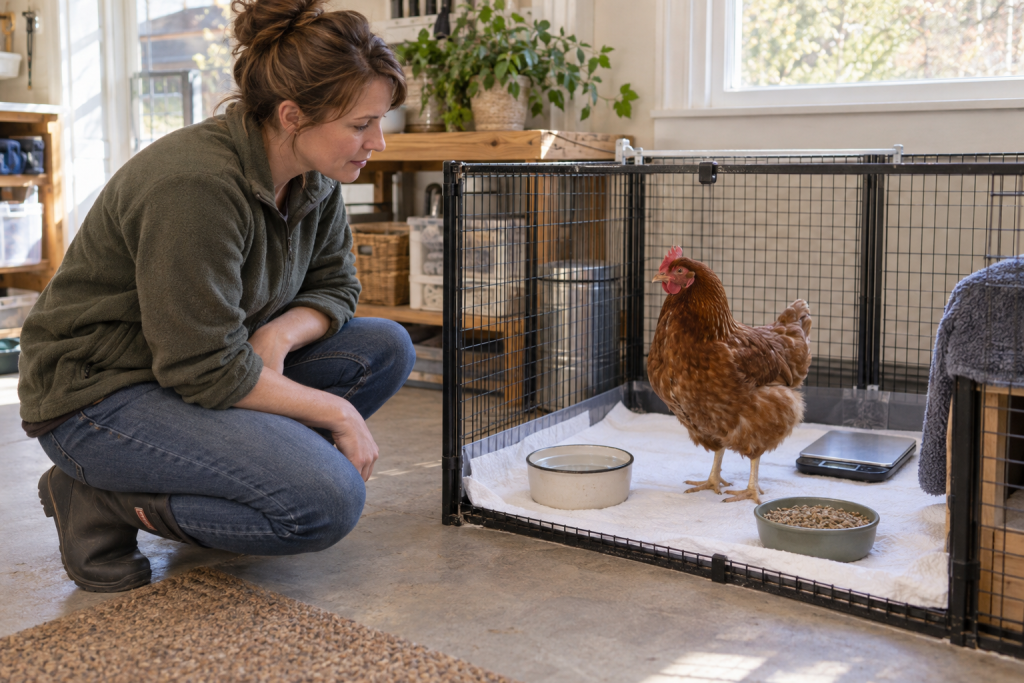
Prepare a small, secure recovery area before catching her. Use a dry nonslip floor, no high roost, no ramp or obstacle, and stable food and water dishes at floor level. The space should be large enough for the bird to stand and turn but small enough to prevent running, jumping, and repeated wing-assisted climbing. Review the complete sick-chicken hospital pen setup.

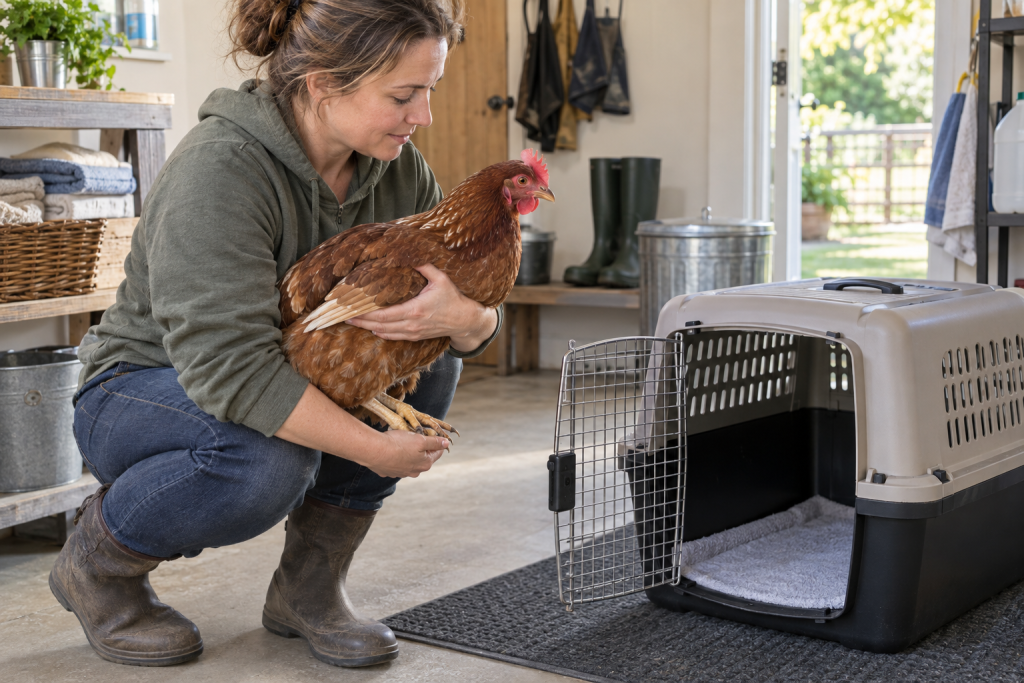
Catch the chicken calmly, contain both folded wings, support both feet and the body, and keep her upright without squeezing the chest. Our safe catch, restraint, and transport guide shows how to avoid adding injury. If she struggles hard or develops open-mouth breathing, stop the exam and let her recover.
Examine Both Feet and Legs in the Same Order
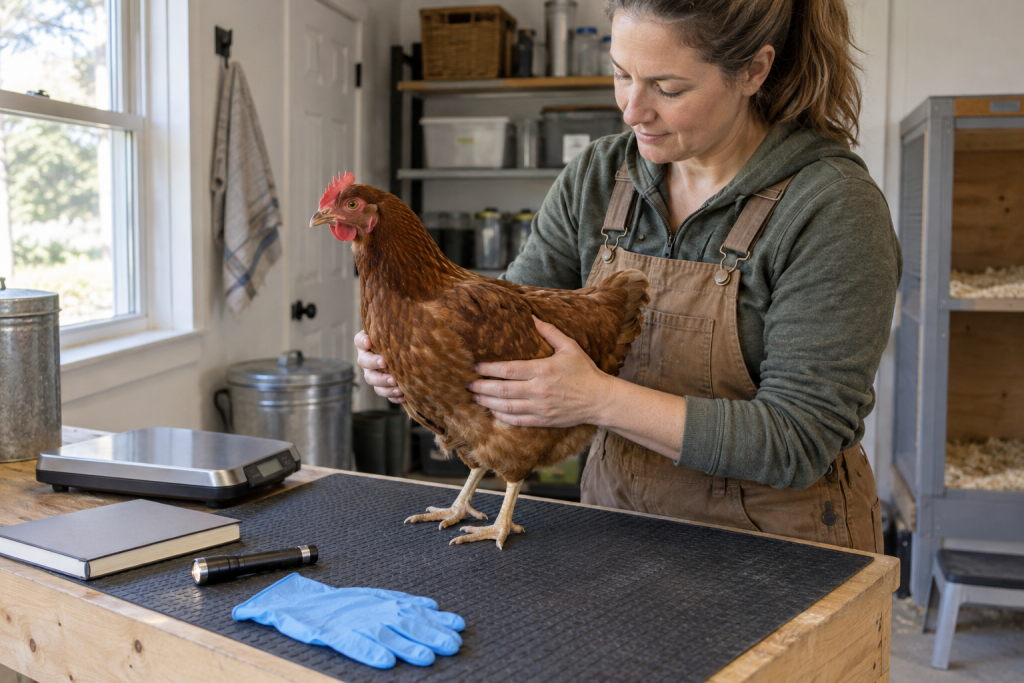
Have one person support the upright chicken while another examines her. Begin with the apparently normal side so you learn the bird’s baseline, then compare the sore side. Good light and photographs help. Do not pull, twist, or force a painful joint through its range of motion.
- Toes and nails: look for a torn or overgrown nail, bleeding, swelling, hair or string wrapped around a toe, frost damage, or a foreign object.
- Footpad: check for redness, a shiny or thinned area, abrasion, dark scab, ulcer, heat, or swelling.
- Between the toes: part feathers and inspect for debris, wounds, swelling, or thread-like material.
- Shank and scales: compare thickness and temperature; note wounds, bruising, raised crusted scales, or pressure from a leg band.
- Hock and lower leg: compare both sides for swelling, heat, instability, or an abnormal angle.
- Upper leg and hip: look for asymmetry, bruising, reduced muscle, or pain, but do not force the joint or pull the leg backward.
- Whole bird: examine the keel, abdomen, vent, wings, body condition, crop, breathing, and neurologic function because lameness may be part of a wider illness.

Merck recommends checking chicken footpads for scratches, swelling, and ulcers and checking leg scales for close, smooth attachment. Use the same systematic approach in our head-to-toe chicken health check, and record weight as described in the guide to checking weight and body condition.
Common Causes of Limping in Chickens
1. Minor Sprain, Strain, Bruise, or Soft-Tissue Injury
A hard landing, awkward turn, flock collision, or struggle can injure muscle, tendon, ligament, or soft tissue without leaving an obvious wound. A mild injury may produce a subtle limp while the bird remains bright and willing to bear some weight. However, a fracture or joint injury can look similar from the outside. Restrict jumping and climbing, provide close resources, and seek an examination if the limp is severe, worsening, or not improving promptly.
2. Fracture, Dislocation, or Major Trauma
Sudden non-weight-bearing lameness after a fall or attack, an abnormal angle, instability, severe swelling, or exposed bone raises concern for fracture or dislocation. Radiographs may be needed to identify the injury and plan stabilization. Do not apply a homemade splint before the injury is localized; a poorly positioned or overly tight splint can worsen alignment, restrict blood flow, create pressure sores, and delay correct treatment.
3. Bumblefoot or Footpad Dermatitis
Bumblefoot is an infection associated with damage to the footpad. Changes can include redness, a shiny irritated area, an ulcer or dark scab, warmth, and swelling. The University of Maryland Extension describes progressive bumblefoot grades from surface irritation to deeper infected swelling and severe lameness.
Do not cut into the foot, dig out a “kernel,” or squeeze a swollen pad based on appearance alone. Deep infection may involve tendons, joints, or bone, and surgery or antibiotics require veterinary direction. Our dedicated guide explains bumblefoot signs, prevention, and treatment considerations.
4. Torn Nail, Cut, Puncture, Foreign Material, or Constriction
Sharp wire, splintered wood, thorns, hard debris, or a torn nail can create pain and a route for infection. String, hair, or a tight leg band can impair circulation and may be hidden by feathers or swelling. For a superficial wound, follow the cleaning and monitoring steps in our chicken wound-care guide. Deep punctures, embedded objects, joint wounds, bite wounds, and circulation changes need veterinary care.
The Vetericyn Plus Wound Care Spray may be useful for a minor superficial skin wound when its current label permits the application. It does not treat a fracture, deep abscess, tendon or joint infection, or neurologic disease. The My Favorite Chicken 15-piece poultry first aid kit keeps basic wound-care and bandaging supplies together, but use only the item appropriate to the confirmed problem.

5. Scaly-Leg Mites
Scaly-leg mites burrow beneath leg scales. The legs may become thickened and encrusted, with raised scales and eventual lameness. Merck identifies microscopic examination of skin material as a diagnostic method and notes that transmission occurs by contact. Do not peel crusts or apply unapproved pesticides. Isolate affected birds, clean the environment, and obtain poultry-specific treatment and egg-withdrawal guidance.
6. Joint, Tendon, Bone, or Systemic Disease
Arthritis, tendon injury, bacterial infection, bone disease, nutritional imbalance, age-related change, and developmental disorders can all alter gait. Chicks and fast-growing birds have different risks from adult laying hens. Multiple affected birds, swollen joints, poor growth, or a feed problem should prompt flock-level veterinary evaluation rather than treating each limp as a simple sprain.
Some diseases require imaging, laboratory testing, feed analysis, or postmortem examination for a diagnosis. Merck’s overview of poultry skeletal disorders emphasizes that infectious and noninfectious causes can occur together and that appearance alone may be insufficient.
7. Neurologic, Reproductive, or General Illness
Leg weakness, paralysis, toe curling, imbalance, or an unusual posture may come from neurologic disease, toxin exposure, severe nutritional disease, or a systemic infection rather than a foot injury. An enlarged abdomen or reproductive disease can also change stance and walking. Use how to tell if a chicken is sick to look beyond the leg, and act promptly if appetite has changed using Chicken Not Eating or Drinking.
What You Can Do Safely While Waiting for Care
- Restrict movement. Use a dry, secure hospital pen with a nonslip floor and no high perch.
- Keep resources close. Place stable familiar feed and clean water at floor level and confirm the bird can reach both.
- Minimize handling. Examine once carefully, document the findings, and avoid repeated manipulation.
- Protect a superficial wound. If present, control bleeding with gentle pressure and follow appropriate wound-care guidance.
- Record change. Take daily weight, gait video, photographs, and notes on swelling, appetite, droppings, and egg history.
- Transport safely. Use a level, ventilated carrier with a nonslip absorbent liner and no high perch. A large poultry pet carrier can provide secure containment when its size and construction suit the bird.
Do not give ibuprofen, acetaminophen, aspirin, naproxen, antibiotics, dewormers, or leftover animal medication unless a veterinarian has selected the product and dose for that chicken. Chickens are food-producing animals, and medication safety, interactions, diagnosis, and egg or meat withdrawal periods matter.
Inspect the Coop and Run for the Cause
While the chicken rests, examine the environment. Look for exposed nails, wire ends, splintered ramps, sharp thresholds, unstable perches, slippery landings, hard debris, gaps that can trap toes, predator damage, and wet compacted litter. A ramp should run securely from the ground or landing to a real, unobstructed coop opening—not to a solid wall—and its cleats should provide even traction without sharp edges.

Keep foot-contact areas dry and remove caked litter. Our guides to wet chicken coop bedding and the best chicken coop bedding options explain moisture management. Penn State Extension recommends lower, appropriately spaced perches and warns that overly high perches can contribute to structural injuries when birds jump down.
What the Veterinarian May Need to Diagnose the Limp
Bring the gait videos, photographs, daily weights, medication and supplement list, feed information, and a clear timeline. Depending on the examination, the veterinarian may recommend radiographs to locate a fracture or joint change; a sample from a wound or swollen joint for microscopy and culture; blood testing; parasite testing; or flock-level feed and disease investigation. A dark footpad scab does not show how deep an infection extends, and a normal-looking foot does not rule out pain higher in the limb.
Ask for written instructions covering movement restriction, bandage checks, medication dose and route, recheck timing, and egg or meat withdrawal. If a bandage or splint is applied, learn how to monitor the toes for swelling, coldness, color change, odor, moisture, and slippage. Contact the clinic promptly if the bird becomes less weight-bearing, stops eating or drinking, or damages the dressing.
How to Monitor Recovery
- Record whether weight-bearing and stride improve, remain stable, or worsen.
- Measure weight at the same time daily and confirm food and water intake.
- Photograph swelling or a superficial lesion with the same angle and lighting.
- Keep bedding dry and inspect the opposite foot, which may develop pressure from carrying extra weight.
- Watch for new heat, discharge, odor, color change, reduced droppings, or systemic illness.
- Follow the veterinarian’s recheck, bandage-change, medication, and withdrawal instructions exactly.
Do not return the chicken to high roosts, a steep ramp, or flock competition after one better step. She should walk comfortably, reach resources, and function safely before gradual reintroduction. Incorporate foot and gait checks into the daily, weekly, and monthly chicken-care routine.
Frequently Asked Questions
Can a chicken limp from a sprain?
Yes, soft-tissue injury can cause a limp, but a fracture, foot infection, joint problem, or systemic disease may look similar. Treat “sprain” as a possibility, not a diagnosis. Restrict risky movement and seek care when weight-bearing is poor, pain is marked, or improvement is not prompt.
Does every dark spot on a footpad mean bumblefoot?
No. Dirt, normal pigment, a superficial scab, pressure damage, and infection can look different under good light but still be confused. Compare both feet, clean only enough to inspect, document swelling and heat, and obtain veterinary guidance before cutting or squeezing.
Should I splint a limping chicken’s leg?
Not until the injury and correct position are identified. A splint for the wrong problem—or one that is too tight, too loose, or poorly padded—can worsen damage. Limit movement and transport the bird securely for evaluation.
How long should a limping chicken be isolated?
There is no universal number of days. Isolation should match the diagnosis, treatment plan, contagious-disease risk, mobility, and ability to compete. Keep the bird separated until she can move and access resources safely and the veterinarian’s restrictions are complete.
Can a limping hen stay with the flock?
A very mild limp may sometimes be monitored in place if the bird can eat, drink, rest, and avoid bullying, but close individual measurement is difficult in a flock. Separate her when movement needs restriction, the cause may be contagious, flockmates target her, or she cannot reach resources reliably.
Bottom line: watch the gait first, protect the chicken from additional movement, compare both feet and legs without forcing painful joints, and escalate quickly for non-weight-bearing, deformity, wounds, swelling, weakness, or neurologic signs. Accurate localization comes before treatment.